Sabtu, 13 Agustus 2016

Olympic Guitars


The Summer Olympics are here and what better time to review some unique guitars bearing the name “Olympic.”

From 1931 through 1950 Epiphone offered an archtop guitar called The Olympic model. This was originally produced by the Staphopoli brothers in their New York facility.


For the first few years this model was fairly small as it was a mere 13” wide, with segmented f holes. By 1933 the width increased 5/8’ths of an inch.

1934 Olympic


In this same year the peak headstock was replaced with a non-peak version. 1934 saw the addition of an Epiphone decal logo with the words Masterbuilt underneath the company’s name.


1938 Epiphone Olympic


Three years later, in 1937, the body was widened to 15.25” and the f holes were no longer segmented.


1937 Olympic tenor
This same year saw the release of the Epiphone Olympic in tenor and plectrum versions. In 1939 a center dip was added to the end of the headstock.


No more changes took place until 1942 when the logo was updated to have a tail underneath “Epiphone.” The guitar was a page in history by 1950, when the company discontinued the model.


Restored Olympic


A different version of this same guitar was marketed in England from the mid 1930’s through 1937. Though produced or just marketed by Epiphone is somewhat of a mystery.


The guitar bore the logo, Apollo, but had an Epiphone Masterbuilt decal on the headstock. It’s body was wider than the Epiphone Olympic, 16” and it came with a standard black pickguard.


The body was made of either mahogany or birch. It may have been built by the Regal Musical Instrument Company for Epiphone distribution.

It was not until 1962 that Epiphone revived the Olympic name. This time it was on a series of electric guitars created during the Gibson CMI period.

The first version of the Epiphone Olympic electric was a thin solid body guitar with an asymmetrical double cutaway. It was Epiphone version of the Gibson Melody Maker. The instrument weighed in at under 6 pounds.

In 1965 the company made a radical change in design of the Olympic that became the basis for many Epiphone thin line solid body guitars.


The body bore a large white pickguard with a large Epiphone upper-case Ѱ, the Greek letter Psi, in the middle of the pickguard. In Greek, Psi translates to "spirit or soul."

The tailpiece was a Gibson Maestro vibrola with a white plastic handle, sometimes called the Walrus tooth arm.


Many of the Olympic models came with one Melody Maker style single coil pickup placed in front of the bridge. There were separate volume and tone controls. The input was mounted on top of the pickguard.

1965 Epiphone Olympic
The 24.75” neck was topped with a rosewood fretboard that was topped with 22 frets. The headstock was the Epiphone Bat wing style with six-in-a-row Kluson Deluxe tuners. All hardware was chrome plated.

The Olympic was also produced in a twin pickup model. This had the same type of pickups with an output of 7.16k and separate tone and volume controls for each pickup. All were mounted directly on the pickguard along with a 3-way Gibson style switch and the input.

This guitar came in a variety of colors. The 1965 Inverness Green model pictured here is very rare.

A soft shell lined case was standard issue with this model. In 1965 this guitar sold for $189.50.

Although Fender never did have an Olympic model guitar, one of Fender’s more popular shades of paint is Olympic White. The finish did not hold up on older models.

As you can see from the pictures, the paint takes on a yellow hue due to the lacquer used and aging. Personally, I like it.

Henley is a relatively unknown guitar distributor. Their products are made Korea. They offered a bass guitar with the name Olympic.

This bass has two pickups that are very different. In the rear the pickup is a Musicman style, while the front pickup is similar to what you would find on a Fender Jazz bass. This instrument has active controls mounted on its body. These include a pickup selector, volume control and a control for low EQ as well as one for high EQ. All hardware is made of die-cast nickel. The neck has a satin finish and the rosewood fretboard is topped with with offset pearloid position markers.

Henley Guitars are run by the husband and wife team from the UK Andy and Denise Henley. They import our own ranges of guitars and sell direct. Due to low overheads and they can offer excellent prices. Denise has a background in importing, shipping and freight. She runs all the administration side of the business and packing and shipping.

Tacoma Papoose
Tacoma Guitars were an acquisition of the Fender Musical Instrument Company. I do not know if Fender has completely closed out the brand or just placed Tacoma on hiatus. Historically, Tacoma was a small Washington state based guitar manufacturer that came out with a very fine and interesting line of guitars. One of their most popular models was an acoustic travel guitar known as the Tacoma Papoose.


Olympia Guitar
After becoming well known, Tacoma launched a budget Korean import model and put the logo Olympia on these models. Though the price point factor was their goal, since Olympia models sold at a considerably lower price than Tacoma guitars. Non-the-less, Olympics were fine instruments.


Olympia guitar
For instance, Olympia guitars model OD-18S came with a solid spruce top with a glossy finish, a 25.5” scale set neck made of mahogany, a rosewood fingerboard with 20 jumbo frets that had abalone position markers. The bridge was mad of rosewood and had a rather unique shape. The neck and body were bound. The rosette was made of abalone. The sides were made of solid rosewood, but the back was made of laminated rosewood.


Olympia guitars came in various models made of differing woods. They also offered mandolins and acoustic bass guitars. All Olympia instruments are designed and set up in the USA .


Finally, there is a manufacturer from Columbia, South Carolina called The Carolina Guitar Company. They offer a distortion pedal known as the Olympia Fuzz. The manufacturer stated they were inspired by the Bender fuzztone and the Big Muff Pi fuzz and named after the Hammer of the Gods. This little pedal has received great reviews.


Anthony Ervin
As a side note, the one Olympian who also is also guitarist, in a band and writes his own music. This is gold medal winner Anthony Ervin, who has claimed two Gold Medals in this years Olympics for swimming in the 50 meter freestyle and the four by 100 meter freestyle relay.


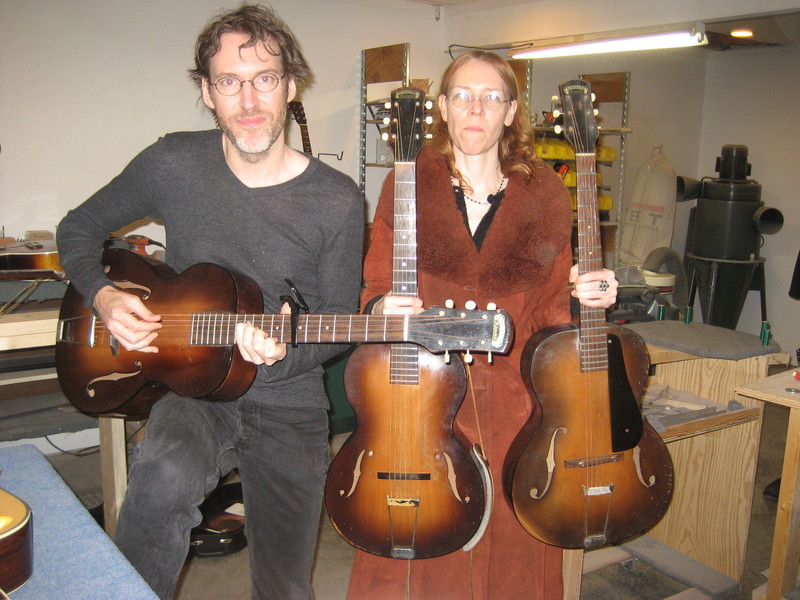
David Rawlings with his 1935 Epiphone Olympic


Minggu, 31 Juli 2016

Skate Board Guitars - Bowery Guitars - Stromberg Guitars - All Made of Re-purposed Wood

Tuesday is trash collection day in my neighborhood. Whenever I drive past homes before the collection and recycling trucks arrive, I marvel at the furniture that is left out as rubbish. It leaves me wondering if this wood can be re-purposed? I’ve seen old wooden chairs and tables that are destined for the trash heap that could be turned into guitars.

If I had the wood working talent and tools necessary to create guitars, I would be up early hauling that wood back to my house.

Alas, I am only a guitar player; not a builder, however there are a few luthiers that have taken up this challenge and ran with it.

Nick Pourfard - Prisma Guitars

In my opinion one of the most unique builders that I have heard about is 24 year old Nick Pourfard. Nick is an industrial design student and a self-taught woodworker who lives in San Francisco.


His garage and basement have been turned into a woodworking shop where he builds his unique brand that he calls Prisma Guitars.

Old Skateboards await to become guitars
Each of these instrument are built out of broken and used skateboards. Nick was a skater and knew that skateboards are not made of plywood, but rather are made of hard-rock maple, usually with seven layers of dyed solid wood.

Skate board deck
In fact the good boards or decks are generally made of maple that has been peeled into veneers and then cured in a climate controlled environment to adjust the moisture content of the wood.

Each veneer is then glued by hand with a water based wood glue. The maple veneer are then stacked according to their grain with some grains running from front to back and other running in the opposite direction. Grip tape is applied over the top of the deck. This "tape" is a sheet of paper or fabric with an adhesive on the backside and a surface similar to sandpaper on the other side. This aids the user in staying on the board, especially while doing tricks.

Nick removing Grip Tape from a board.
When Nick find old skateboards the initial step is to remove the grip tape, either by hand or with a knife. He then shapes the boards and glues them together in a press.


Prisma Guitar body template

Once the wood is sanded flat  he shapes the finished product by use of a template to outline the guitars body shape. This is then cut out using a band saw.


Routing out a Prisma Guitar
Another template is applied to outline the area needed to be routed out for the neck pocket, pickups, hardware, and electronics. Necks are done in a similar fashion. The wood is glued, pressed and shaped into a basic square neck shape.

Shaping a neck


Various files are used to hand shape the neck and the headstock. The results are stunning.


Prisma Guitar Bodies
The various colours of the diverse skateboards show through, creating a beautiful design that would be hard to capture in any other way. No painting is necessary; just a spray of clear coat. Although Nick does paint some of his guitars.

Prisma Guitar logo
One on the more unique features of Prisma guitars is the triangular, multi-colour, striped logo which is reminiscent of a pyramid point guitar pick.


This is inlaid in the guitars headstock and at the guitar bodies base, where the end-pin fits. Nick has also applied his guitars features to a line of guitar pickups.

Rick Kelly


There is only one other existing builder that I am aware of who uses re-purposed wood in his builds. This is Rick Kelly of New York City. All of his guitars are made from reclaimed lumber from wood procured in the 1970’s at farm auctions.


Kelly Bowery Guitars
He also has a line of what he refers to as Bowery Guitars that are made from wood that was barged down the Hudson River more than 200 years ago; wood that was harvested from the forests of the Adirondacks.

This was lumber used to frame buildings that were erected in the 1800’s. As these buildings were demolished, Rick Kelly was able to obtain some of what he refers to as “Kings Wood” to build a unique line of instruments. Most of this wood is pine.

Kelly gluing boards together
Instead of using one large billet for the body, Kelly must glue two sides of book-matched lumber together to form the body. The  grain in the pine wood is quite prevalent and the result is beautiful. He even leaves the knot is the wood in the instruments body, which gives it character.


Bill Kircher with Kelly Bowery Pine
Rick Kelly has some lovely creations that are favored by such players as Bill Kircher, Bill Frizzell and G.E. Smith. Kelly stresses that most solid guitars are made from green wood that is kiln dried, which cuts down on vibration.

Rick Kelly guitars

His instruments are made from air dried timber that has aged through the years. The natural resin in the wood has crystallized which leaves the pores open to vibration. Kelly makes some fantastic instruments. Most are based on Fender body shapes, however Kelly has modified them in his own unique way.


Charles Stromberg


The last builders that I am aware of that utilized re-purposed lumber were Charles Stromberg and his son Elmer. Both died in 1955. During their lifetime, the Strombergs came out with a series of guitars that were built to rival Gibson’s popular Super 400 model.


Stromberg Master 400


The Stromberg series Master 300 and Master 400 models built from the 1930 through the 1950’s are sought after and now command prices in the tens of thousands of dollars.


Elmer Stromberg
Charles and Elmer had a shop in Boston Massachusetts and it is written that they frequently went to buildings that were either being demolished or being reconstructed. The men purchased lumber from these sites for use in their builds. Perhaps it is because of this old wood that their guitars are known for being louder than Gibsons or D'Angelicos of that same era.


Click on the links in the pictures or the text for my sources.


Minggu, 24 Juli 2016

Black Diamond Strings

Ed Sullivan and the Beatles 1964

In 1964 the Beatles made their first United States appearance on the Ed Sullivan television show. At that time I was 13 years old and like kids of that era I had to have a guitar.


Harmony Patrician

My Dad relented and bought me a late 1940’s era Harmony Patrician archtop acoustic guitar from a local pawn shop for $20.00. The salesman that sold it to Dad said, “Well you need a couple of things to go along with that guitar. You need a pitch pipe to tune it and you need an extra set of string, ‘cause that kid is going to break ‘em.” For an extra two bucks I got a pitch pipe and a new set of Black Diamond guitar strings.


Larry Cordel "Black Diamond Strings"

I had not thought much about those strings until last week when I turned on a local radio station that plays a variety of diverse music. That day they were playing Country music by some unfamiliar artists.


Black Diamond Strings Set
One song caught my ear since it was called Black Diamond Strings. It was all about how much joy they brought to guitar players back in the day.

Which is odd, because I recall how difficult it was to play guitar with those thick heavy guage old Black Diamond strings.

The strings on the neck on that old Harmony were probably a good half and inch above the neck at the 12th fret.

And when I put them on my first electric guitar, a late 1950’s Fender Stratocaster, the bridge saddle and block raised off the neck, which was great because the vibrato pulled up and down. But bending notes was another thing with those heavy strings. And talk about sore fingers and calluses!

Black Diamond Set
However Black Diamond Strings were available everywhere. You could get them at a drug store or a five and dime store. If you broke a number one E string you could get another for 20 cents. A pack of six new Black Diamond strings cost around three bucks.


1960's Gibson Guitar Strings

I was not aware that both Gibson and Fender sold their own brand of strings until a few years later. And it would be another ten years or so before Ernie Ball started putting string sets together with light and ultra light guage strings.


As we were kids, we had no idea that professional players were discarding the sixth string and replacing the first string with a .009 banjo string  and then using the remaining five strings.

Bell Brand Strings
After hearing that song I was very curious about Black Diamond Strings and there origin. I learned that the company that made them got started in 1897 when a merger occurred between three different companies; the Rice Musical String Company of New York, which was owned by Thomas Nelson Jr which made Bell Brand strings and the Standard Musical String Company of Connecticut.

The Standard Musical String company was owned by a Mr. Alexander Paul, who had already been making his own brand called Black Diamond strings. The last partner was a Mr. George Dow Emerson, who owned yet another a string factory in New Jersey. These men got together to form the National Musical String Company

National Musical String Co. 1898
The first step was the purchase of a factory building in Brunswick, New Jersey on Georges Road and the cities boundary. This structure was designed by a Mr. Ben C. DeKamp in 1897 specifically for this company. In fact it still stands in that same place to this day. The following year, 1898, the business started up.

NMSCO office

Interestingly enough advertisements for employment went out looking for mostly women employees. By 1899 the partners purchased another manufacturer called the American String Company.

Black Diamond stamping plates
It was in 1917 the last remaining partner, George Dow Emerson sold his shares to a Mr. William R. McClelland. Fifteen years later McClelland died unexpectedly of a heart attack.

This was in 1932 and the National Musical String Company was then bought by C. Bruno and Son Incorporated and James and Frank Gibson, who owned the Gibson String Company (which was not associated with Gibson Guitars).

From C. Bruno catalog - U of I library
Let me pause here because the history of C. Bruno or Charles Bruno is very interesting. Way back in 1837 Bruno was a bookseller. The following year he entered into a partnership with Christian Martin (yes THAT Christian Martin). Martin would manufacture guitars and Bruno would sell them.

Christian Martin


The partnership only lasted a year and both men went their separate ways, with Martin building guitars and Bruno selling musical instrument as a wholesaler.


C.Bruno and Son catalog
In 1851 Charles Bruno established another partnership with a man named Cargill that lasted for two years after which Burno brought his son, Charles Junior into the business. The company sold not just guitars and banjos, but all sorts of band and orchestral instruments, accordions, drums, harmonicas, music boxes and children's toy musical instruments. They became one of the largest music wholesalers and importers in the United States.

Bruno and Son was eventually purchased in 1970 by the Kaman Music Corporation (Ovation Guitars) and renamed the Kaman Musical String Company. The business was moved from New Jersey to Kaman’s headquarters and factory in Bloomfield, Connecticut.

National Musical String Co - today
However in 1982 the original National Musical String Company building in Brunswick, New Jersey was declared a historic landmark, as it was one of the oldest standing buildings in the state and it was placed on the list of national landmarks. Since then it was renovated for commercial space on the first floor. The upper floors house 38 residential apartments.

Black Diamond Strings - circa 1965

As I recall Black Diamond strings were sold in a black cardboard container with six individual reddish packs, each containing a string. The gauge of the string was not listed on the box or the pack, but instead it said B or 2nd Steel or E or 1st Steel. All I can say is they were heavy strings.


Individual strings
The container and each pack bore a quadrangular logo in the upper left corner with the company’s trademark stating NMSCO (National Musical String Company).  Some of the guitar strings would say silver plated steel while others would say silver plated copper wire. By far the most popular Black Diamond Strings were the silver plated stainless steel versions.

The National Musical String company made strings for guitars, Hawaiian guitars, banjos, mandolins and other instruments. I have also come across Black Diamond electric guitar strings that were made in later years.

Display Case for individual strings.

Back in the mid 1960’s most players that I knew did not purchase a new complete set of strings. More often than not if a string broke or sounded dead, we went to the music store and bought an individual string and those stores all stocked individual Black Diamond strings.


I was not certain if Black Diamond strings were still available and being curious I learned that in 1930 Ed Wackerle of Chicago, started a company to manufacture strings for bowed instruments. He was upset with the quality of strings being offered at the time. To achieve quality he put together an endorser panel; a group of players that would test the strings and suggest improvements. He came up with stainless steel strings and marketed them under the Red Label brand.

Then in 1967 John and Vincent Cavanaugh purchased the company and continued to manufacture Red Label strings. They moved the business to Sarasota, Florida

By 1972 a research and development department was set up to further enhance the strings quality. Out of this came the Old Fiddler Line of strings for Country, Western and Bluegrass players.

Improvements were made on cello and bass strings with the Supreme Line. The business was renamed the Super-Sensitive Musical String Company. In 1997 the grandson of the company’s founder took over the reigns and introduced computerized manufacturing.

John and Jim Cavanaugh
And in 2001 the Cavanaugh family purchased the name and trademark of the National Musical String Company/Black Diamond Strings. Once again, Black Diamond Strings are available, although under a new manufacturer with a high quality than ever before.

Current version Black Diamond strings
Black Diamond currently offers three different sets of electric guitar strings, including flat-wound strings and four sets of acoustic guitar strings, which include the original silver plated steel strings (.013 to .056) as well as 12 string guitar sets. These are available directly from the manufacturer www.blackdiamondstrings.com.

A special thanks to Chris of the Mudcat Cafe for some very interesting information on the history of the National Musical String Company.


This was written by the late Guy Clark in honor of Rodney Crowell's father