Pete Huttinger, who was a finger-style guitarist died today January 16, 2016. He was only 54 years old. Pete was a most amazing player and an even more amazing person.
Pete with CB Guitars model J
He was born with a congenital heart defect and had his first open heart surgery at the age of 13. In 2010 he suffered a stroke and was paralyzed on the right side of his body. It was a struggle to regain control not just of his paralysis, but of his speech as well. Although he had been playing guitar for most of his life and was a finger style champion, it took him a year to relearn the instrument.
His sister’s husband was a big influence on his music and style. This man played old time music with his friends,and Huttinger grew up listening those antiquated and delightful songs.When Pete was a teenager his mom bought him a banjo from a Sears catalog. He says that finger picking the banjo just seemed to come naturally to him which was very helpful when he eventually gravitated to guitar. He applied this same banjo "finger style" method to the guitar.
During his late teens he played electric rock and roll guitar. Upon finishing high school Huttinger attended the Berklee College of Music, earning a bachelor degree.
Playing banjo with John Denver
By 1994 to 1997 he was in John Denver’s group, only leaving after the singer’s death.
Since then Huttinger went on to play on stage at Carnegie Hall in both 2007 and 2008. He was scheduled back in 2010.
At 2010 Crossroads festival
Huttinger was invited by Eric Clapton to perform at his Crossroads events. Huttinger has performed on some Grammy winning projects and was an Emmy nominee for music he wrote and performed on for PBS specials.
He also created the theme song for a national TV series on fly-fishing (this was his hobby).
After his 2011 hospitalization he went on public speaking engagements to let others know his philosophy, which was Don’t Just Live; Live Well
In 2013 Huttinger released, what is considered his finest work, McGuire’s Landing. This was a LP of original songs which was accompanied by a 52 page story that he wrote.
Pete's final show on January 9th, 2016 was in Atlanta. Two days later he was back in the hospital with bleeding on his brain. He went from talking and laughing to being unresponsive.
For the past five years he had worn the Venticular Assist Device. This was essentially a pump for his heart. It came with a battery pack that was in a bag that he wore over his right shoulder. There were wires coming out of his belly that were attached to the batteries.
He would make fun of this in his concerts by telling the audience it was “set to stun. He even gave it a name.
Huttinger was a regular at guitar instructional camps and was quite fond of Jorma Koukenan’s Fur Peace Ranch in central Ohio.
Although he played other acoustic guitars, Huttinger’s favored guitar was built for him in 2012 by renowned luthier Bill Collings. This guitar was a modifed model OM1 that had a limited run of 50 instruments. The guitar listed at $4725 and Collings gave $1000 for each instrument to a fund for medical bills that Huttinger had incurred. The street price was $4000. USD.
The Huttinger model guitar’s top was made of Sitka or Adirondack spruce with a Venetian cutaway. The back and sides are solid mahogany, as was the guitars neck. The back and sides were trimmed with tortoise shell style binding and the back had a strip of walnut separating the sides. The neck was a bolt-on model with a heel and has a modified V shape. The fretboard is ebony with dot position markers and Huttinger's name in script on the 12th fret.
The body had standard scalloped X bracing. The nut at the neck was slightly larger than the standard model and is 1 3/4” and tapers to 2 3/16’s at the saddle. The Waverly tuners were made of nickel.
Huttinger can be seen in a John Denver TV specials playing a banjo and mandolin. Huttinger was a spokesperson for Elixir strings said that he he was fond of slightly heavy strings. He used a 013 for high E and .017 for B.
AER Compact 60
He ran his guitar through an AER Compact 60 amplifier that he lsaid maintained consistency in sound for his performances and acted as a monitor. His OM1 is equipped with a Fishman Matrix Infinity pickup. The controls are mounted inside the guitars soundhole.
He also uses a Fishman Aura Spectrum DI.
For some songs he states that he used modified tunings, such as D-A-D-F#-A-D.
Pete with his classical guitar
Pete also said that he plays a Collings OM2, a Collings D1, a Larrivee custom made guitar, a Keith Adams classical guitar, a Takamine classical guitar, and two Fender electric guitars; a Telecaster and a Stratocaster.
Additionally he owned a Gibson ES-335, a 1938 Gibson L-50, a 1950 Gibson L-7, a National Dobro, and a guitar made by TV Jones. He also owns a 1968 Gibson Mastertone 5 string banjo, a Gilchrist Model 5 mandolin, a 1924 Gibson style A-2 mandolin and a Collings MT mandolin. In addition to these he owned an Irish Bouzouki, a Cuban Tres and a Brazilian Cavaquinho.
One of the most unique brand of guitars came from the former country of Czechoslavakia, under the brand name of Jolana.
Josef Ruzicka
The company had it’s beginnings in 1953 when the Rezonel factory in the town of Blantne, under the supervision of Josef Ruzicka. M. Ruzicka was part of a cooperative known as Drevokov. The name means “Woodmetal or Woodcraft.” At the time the organization’s chief product was furniture. Under the direction of Ruzicka the company began the manufacture of electric guitars.
The organization was run as a cooperative because after WWII, Czechoslavakia was under the heavy hand of Communist rule and all private enterprise was forbidden. So privately owned companies were forced to become nationalized.
Resonet Akord
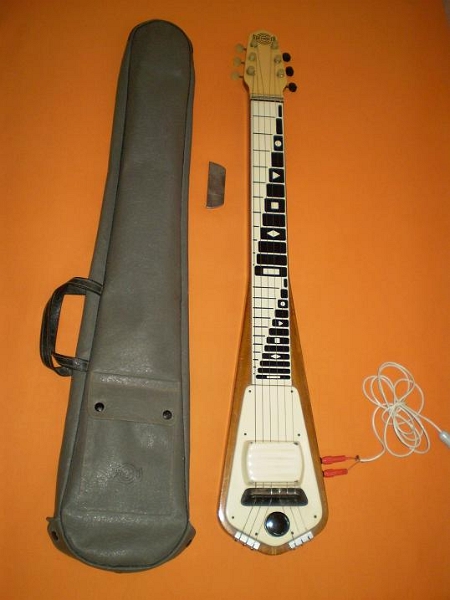
The first product was an art deco lap steel guitar designed by a Mr. Vicek which was called the Resonet Akord and offered for sale to the public in 1954.
The word Resonet seems to apply to many of the Czech-made electronic instruments. It is found on the pickups and scratch plates instead of the headstocks.
This first lap steel was followed the following year by another lap steel guitar known as the Arioso Resonet.
Jolana Arco Bass
Their next design was a very unique upright bass instrument called the Arco. This was a double bass with electric pickups mounted on the end of the neck. This was seven years prior to when Ampeg built a similar electric double viol known as the Baby Bass.
Resonet Gracioso
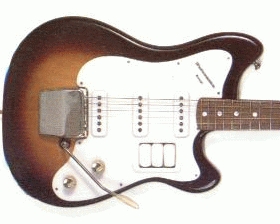
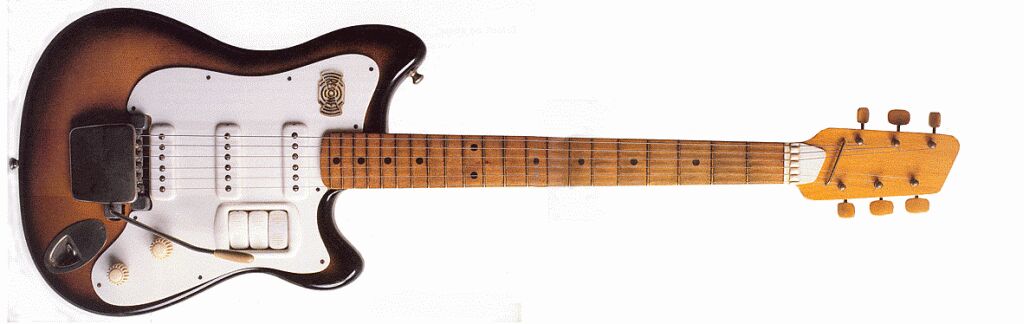
In 1955 Jolana got into manufacturing their first solidbody "Spanish" guitar by building a guitar called the Resonet Graciozo.
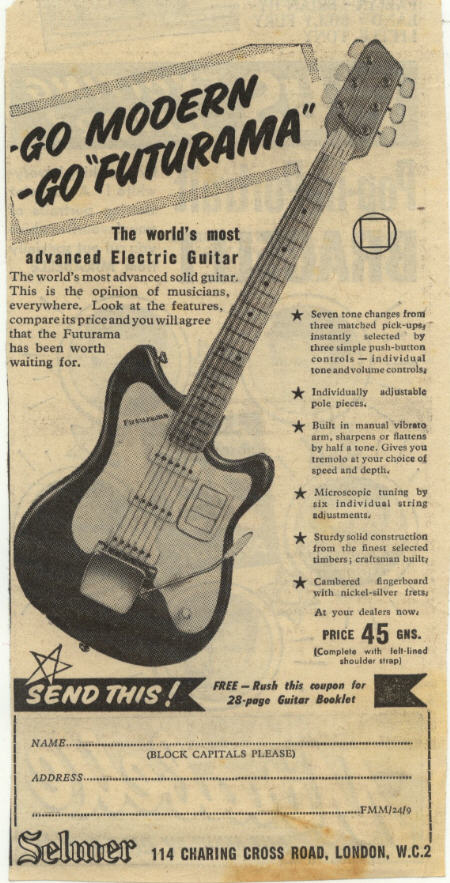
It was definitely modeled after Fender’s Stratocaster. And this guitar became a big hit in Europe, due to the fact that the Selmer Company of Paris began selling these Czech made guitars.
Selmer Futurama
Although they did not actually put the Selmer name on them, it was assumed they were Selmer guitars. Many of these instruments bore the logo Resonet on the scratch plate; some came with a decal that said Graciozo.
Selmer Futurama Bass ad
As I’ve related in the past, due to the heavy tariffs placed on American imports in the 1950’s it was nearly impossible to purchase a US made guitar.
Most British and European music stores stocked only European manufactured guitars. Britain had issued an embargo on US made goods that was not lifted until 1959.
Harrison's Futurama
So it was in 1957 when the Selmer Company of Paris had inked a deal with the Czechoslavakian manufacturer to sell their products throughout Europe and the United Kingdom. The first guitars to arrived were the Graciozo and the Arco bass. Both were advertised as the Futurama guitar and Futurama bass.
Jimmy Page with a Futurama
Guitarists such as George Harrison, Jimmy Page and Eric Clapton got their start with one of these instruments. Harrison used his Futurama during much of the Beatles early career in Hamburg. It can be heard on their recording of My Bonnie.
By 1959 production in Blatne ceased and all guitar manufacturing. The new head of the company detested guitar manufacturing, so all guitar manufacturing was moved to the city of Hradec Kralove. However there was still much unsold stock that needed to be depleted before the company could resume its primary industry; furniture manufacturing. So guitars manufactured in Blatne continued to be sold up until around 1964.
Since all guitar production was nationalized, the cooperatives move was done by the Ministry of Industry under the auspices of the Ceskoslovenske Hudibni Nastroje or CSHN. Which translates to Czechoslovak Musical Instruments. There were similar factories in other cities that produced guitars. So in addition to Hradec Kralove, the other cities included Krnov and Horovice, and Cremona Luby, but because of the centralization by the CSHN, we likely know these instruments collectively under the Jolana logo.
Jolana Star III
The move prompted the new cooperative in Hradec Kralove changed the name of the Graciozo to the Star and Star III models. The Resonet name was dropped. Import models were still marketed under the Futurama name.
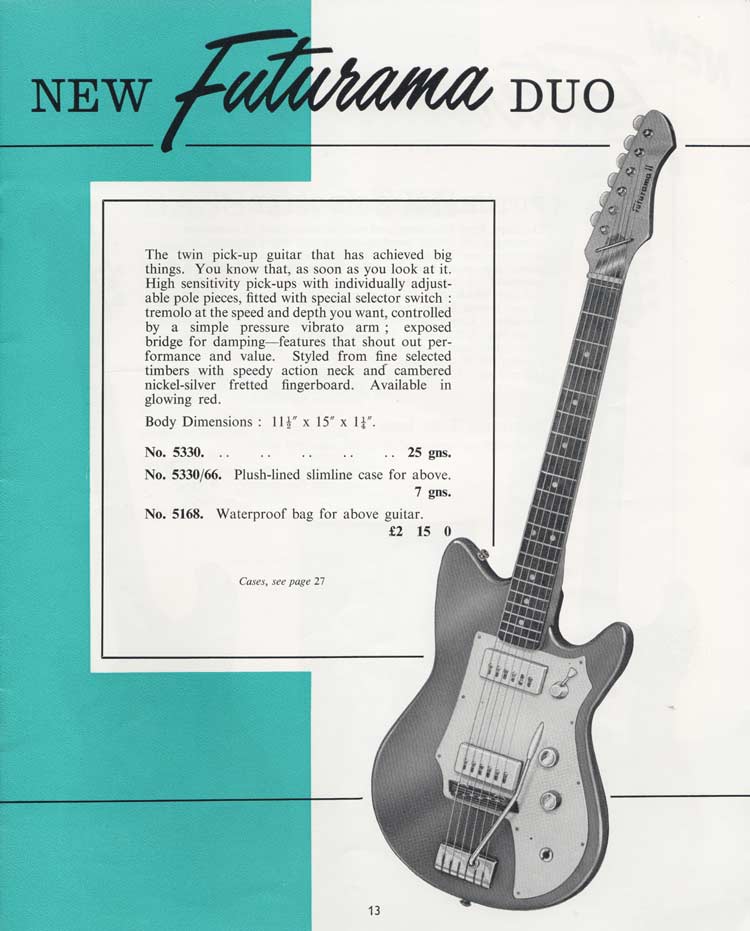
Star / Futurama Duo
Since the embargo was lifted, marketing strategy had to change. So a new downgraded model was being offered at a reduced price, due to competition from US manufacturers and Asian imports that had caused a decline in the companies sales.
On the plus side, this competition prompted improvements to their guitars. 'sounds like Capitalism to me, but I digress.
Star IV
On the new models the input jack was moved from the top of the guitars to the lower side of the body and the vibrato unit was improved. The new unit was similar in design to Leo Fender’s floating tremolo, be it a primitive version.
Jolana Neoton
In 1959 a new guitar dubbed the Neoton was being offered. By 1960 the company renamed itself Jolana, after the Josef Ruzicka’s daughter.
In fact the Neoton was the first model produced under the Jolana name.
Jolana Neoton
The Neoton was an archtop electric with twin pickups mounted on the body next to a triangular shaped scratch plate. It was a thin depth hollow body instrument with two cat eye “f” holes. The pickups were branded Brilliant Deluxe and resembled P-90’s. The neck on this guitar was bound. Its electronics included two volume and two tone controls. The fretboard was made of rosewood and it bore block shaped pearloid position markers.
This tailpiece was similar to the finger tailpiece on some expensive Gibsons, but was not nearly as well made. The bridge/saddle was a wooden unit and had adjustable individual metal saddles, The neck is set in with two screws at the base of the body securing its attachment. A matching bass named the Jolana Basora was produce as well. Jolana seemed to always create a bass to go along with their guitar models.
Jolana Marina
The next model was similar in most aspects to the Neoton, except for the electronic controls and the tailpiece. This instrument was called The Marina. The controls had changed. The knobs were replaced with five buttons, that were mounted on the distal side of a large, aluminum triangular pickguard. The trapeze tailpiece could be solid or many models came with a vibrato bar. The bridge saddle was made of wood and and adjustable for height. The bridge appears to be made of ebony. It was topped with an unusual system of adjustable metal saddles. This guitar had a set in neck. I have seen different versions of the Marina.
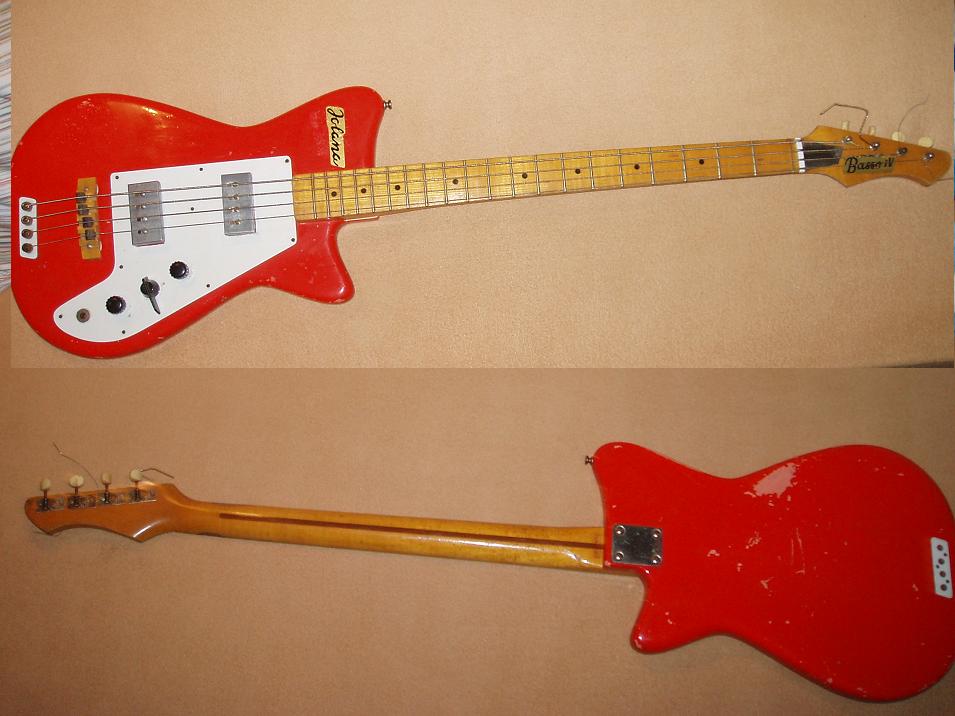
Jolana Basso IV
The Basso IV was also offered around this same time. It was similar in appearance to some of the Star models (Futurama) as it was a solid body instrument. It featured twin pickups and a four-in-line headstock.
Jolana Basso IV
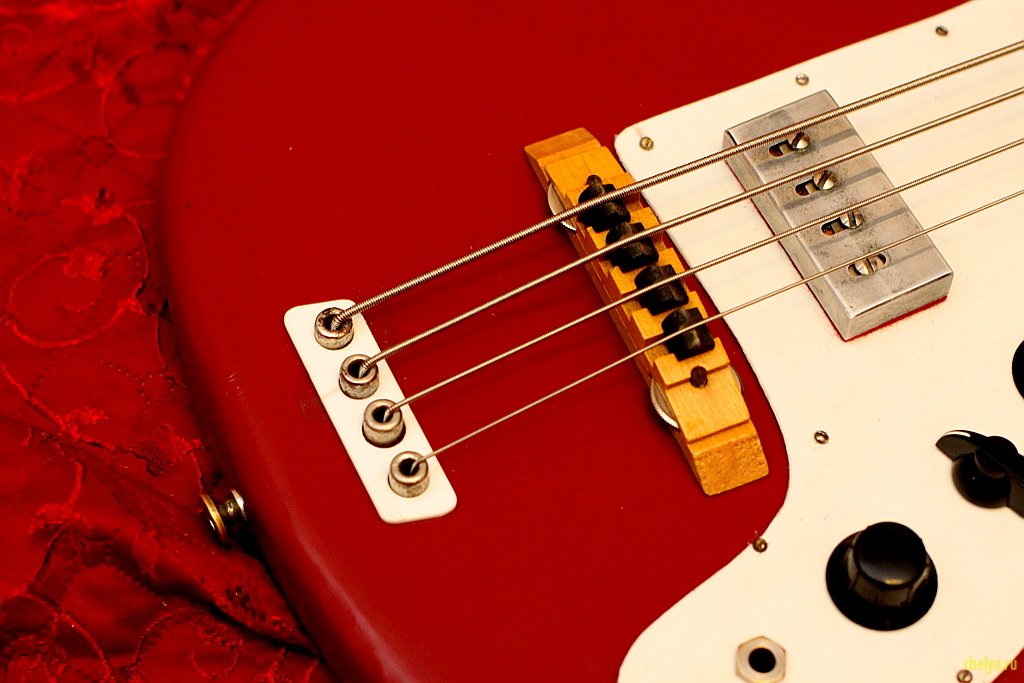
It was obviously designed after the Fender bass guitars of the day, but for the twin pickups; one in the neck position and the other in the bridge position and the archtop style adjustable bridge and saddle unit. This bass came with a bolt on neck.
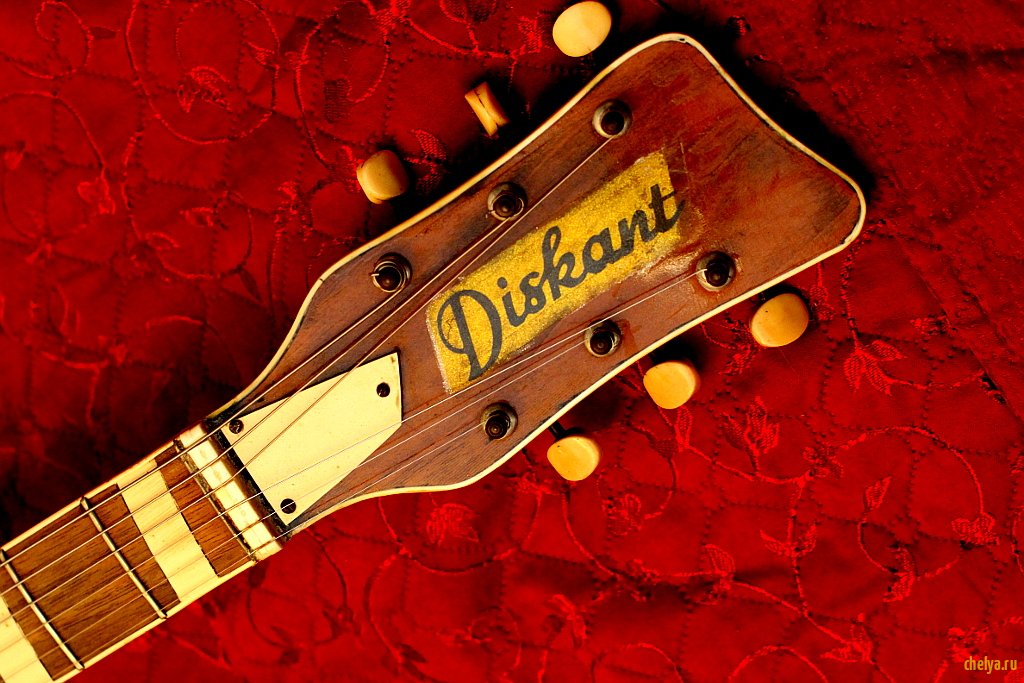
Despite the setback, Jolana continued to manufacture electric guitars and basses. These included a model known as the Diskant. It retained the same body shape as the aforementioned guitars and came with the same triangular pickguard. Even the neck, position markers and headstock were similar.
Jolana Diskant
The neck was set in. The key difference seems to be there were only three controls; a volume potentiometer and a tone potentiometer and another knob that was a 3 position switch for the twin pickups. Some models came with the finger-style trapeze tailpiece, while others had a Bigsby-like vibrato tailpiece. The bridge saddles on all this guitars was an adjustable wooden archtop style unit with moveable metal saddles.
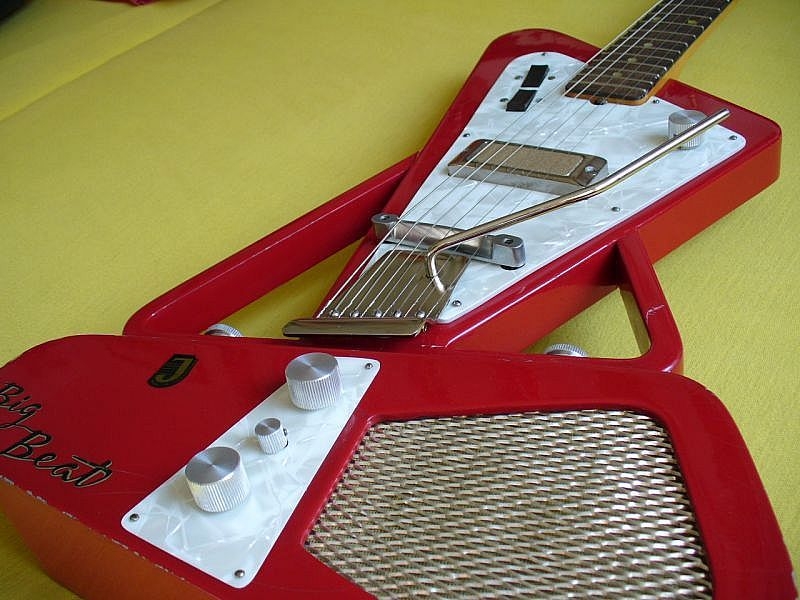
Perhaps the oddest guitar that Jolana had produced was The Big Beat. This guitar rivaled any Wandre instrument.
Jolana Big Beat - built in amp
The Big Beat had a triangular shaped body with a wooden frame at the end of the body. A mother-of-toilet seat pickguard mimicked the shape of the body. The guitars one pickup was set about 2 inches about the all metal bridge saddle.
On the upper bout were two rocker switches that were the instruments tone controls. On the lower bout was a single volume knob. The one piece neck was lacquered maple and had an angled headstock that also mirrored the angle of the body. This guitar even included a vibrato tailpiece
But by far the strangest thing about this instrument was the battery powered amplifier that was attached to guitars wooden frame by two roller bolts. A large decal guaranteed this to be a Big Beat.
Jolana Big Beat Amp/Radio
The 2 watt removable amp was powered by four batteries and had an on/off switch along with 3 potentiomers. When you were tired of playing guitar, the amp was switchable to use as a radio.
Jolana Tornado
In 1963 the Tornado was Jolana’s newest guitar. This was a double cutaway thinline electric guitar with a six-in-line headstock that was reminiscent of Gibson’s Trini Lopez standard. The instruments semi-hollow body had a center block.
Jolana Tornado
The soundholes were more conventional “f” style cuts. This guitar came with a metal bridge and saddle with a flip-up mute and an interesting roller style vibrato and tailpiece.
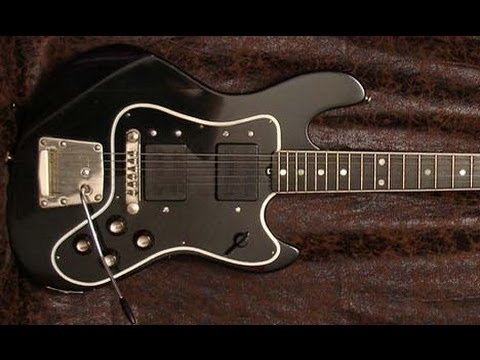
Most interesting however was the large black pickguard/electronics assembly. This housed three single coil pickups and what appears to be two circuits that are similar to what we find on the Fender Jaguar/Jazzmaster. There is one rocker switch on the upper bout with two thumb wheel controls below it.
On the lower bout were four rocker switches that control the pickup combinations. Furher down, below the bridge were two potentiometers, which we can assume are for volume and tone. The assembly also featured a standard input jack.
The neck guitars neck was bound with dot position markers. The neck on this instrument was attached to the body by four screws and a metal plate.
Strap Button Screw Driver
One extraordinary feature on this guitar and many other Jolana guitars was the strap button on its body. It could be unscrewed from the body and when pulled out it is a screwdriver that can be used to make quick repairs to the Tornado.
This guitar was sold with a gig bag that came in two pieces. One piece fit over the neck and the other covered the body. The could be attached together by zippers.
This bass had a metal adjustable bridge/saddle unit and the strings were secured by a trapeze tailpiece.
The neck was bound with a rosewood fretboard and dot position markers. The headstock was four-in-line. This bass came with a large black scratchplate with twin pickups and all of the electronics were mounted upon it. These electronics consisted of four rocker switches that provided various pickup combinations. Additionally there was a single volume control and an input jack mounted on the plastic plate. Just like the guitar, the neck on this bass was attached to the body with four screws and a metal plate.
Jolana Special
Around 1970 two more models were introduced that were quite similar to the Tornado; The Special and The Rubin.
The headstock on the Special was more Fender like, but still six-in-a- line, but not as severe as teh Tornado's headstock. The controls were not nearly as elaborate for this three pickup guitar.
Jolana Special
They were also mounted on the scratchplate and included four potentiometers for volume and tone, as well as four rocker switches that controlled the pickup selection. The bridge/saddle was more of a roller style arrangement and it had a flip up mute.
This guitar had a vibrato on a roller, that was in the style of a Bigsby. The instruments bolt-on and bound neck bore a rosewood fretboard with dot inlays. This guitar also came with the two-piece neck/body gig bag.
Studio Bass
The bass guitar that matched the Special was of a similar shape to the Special was known as the Studio bass. The instruments body style had a similar shape. Once again the bolt on neck was bound with dot inlays and the headstock was four-in-a-line. The electronics on this bass were a much simpler arrangement with only two single coil pickups and two potentiometers.
The basses bridge was metal and the trapeze tailpiece had a stylized “J” between the bars.
Jolana Rubin
The other model known as the Rubin was a stripped down version of the Special. As with the aforementioned instruments the neck was of a bolt on style, but this time with a 3 per side tuning key arrangement. The Rubin came with two blade style pickups mounted on the body with a metal surround at their base. The original models came with a triangular pickguard that was different than the first series of guitars manufactured in the late 1950.
The simple electronics were on the lower bout on a metal plate and consisted of a volume and tone know and a selector switch. The upper bout had but one unbound “f” hole. The bridge saddle appears to be mahogany with plastic adjusts mounted on top. The tailpiece was of the finger style.
Jolana Kolorbas
The bass that matched the Rubin was called the Kolorbas. The style was quite similar right down to the electronics. The headstock was four-on-a-side and looked more like the Tornado headstock.
This is a guitar that Gibson considered too close to its ES-335 and it is rumored that there was the threat of a lawsuit.
This guitar certainly had the “335” body shape. And these were the infamous “copy” era. However Gibson only filed one lawsuit against Elger Music, which was the US importer of Ibanez guitars, but that suit was enough to shake up the entire industry.
Jolana Alexandra
The Alexandra sported twin single coil pickups with black plastic surrounds. The bridge was probably made of mahogany and the angled saddle was a thin strip of metal. The strings were anchored to a Bigsby style vibrato. On the guitars upper bout was a selector switch and the lower bout there was another toggle switch. The bottom section of the guitar bore two knobs for volume and tone.
The Alexandra's pickguard was a gold MOT stylized design. And though it was a very lovely instrument, it was certainly not up to Gibson's ES-335 standard.
Jolana Star IX
Perhaps the most original and unique Jolana guitar was the Star IX. This guitars body was a wedge-shaped oddity with two long sides and two short sides and a flat bottom. The instrument came with two angled single coil pickups that had pole pieces much like Fender single coil pickups. These were mounted on a white plastic scratch plate. The controls were placed directly below on a triangular plastic plate.
Jolana IX
The original models featured three controls, with one being a knob and the other two had pointers. In researching this I have seen several control arrangements. Early models came with a wooden bridge saddle, while later models had a metal adjustable bridge. All had a Jazzmaster style floating tremolo.
The neck of the Star IX was made of maple with a rosewood fretboard. The headstock came to a point and had a 3 and 3 arrangement of the tuning keys.
Basso IX
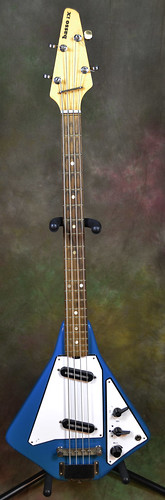
Jolana made a bass version of this guitar called the Basso IX.. It also had twin single coil pickups, and came with a single volume and tone control. The bridge was metallic and a metal hand rest covered the point of attachment.
This guitar came with a very unique offset body that looked like it was designed by NASA. The upper and lower horns came to a point and the butt end of the body was diagonal.
This guitar had a Jazzmaster style floating tremolo and a metal bridge with adjustable individual saddles. It also had three humbucking pickups. The input jack was like a Stratocaster jack,. I've seen some models where this jack is mounted backwards.
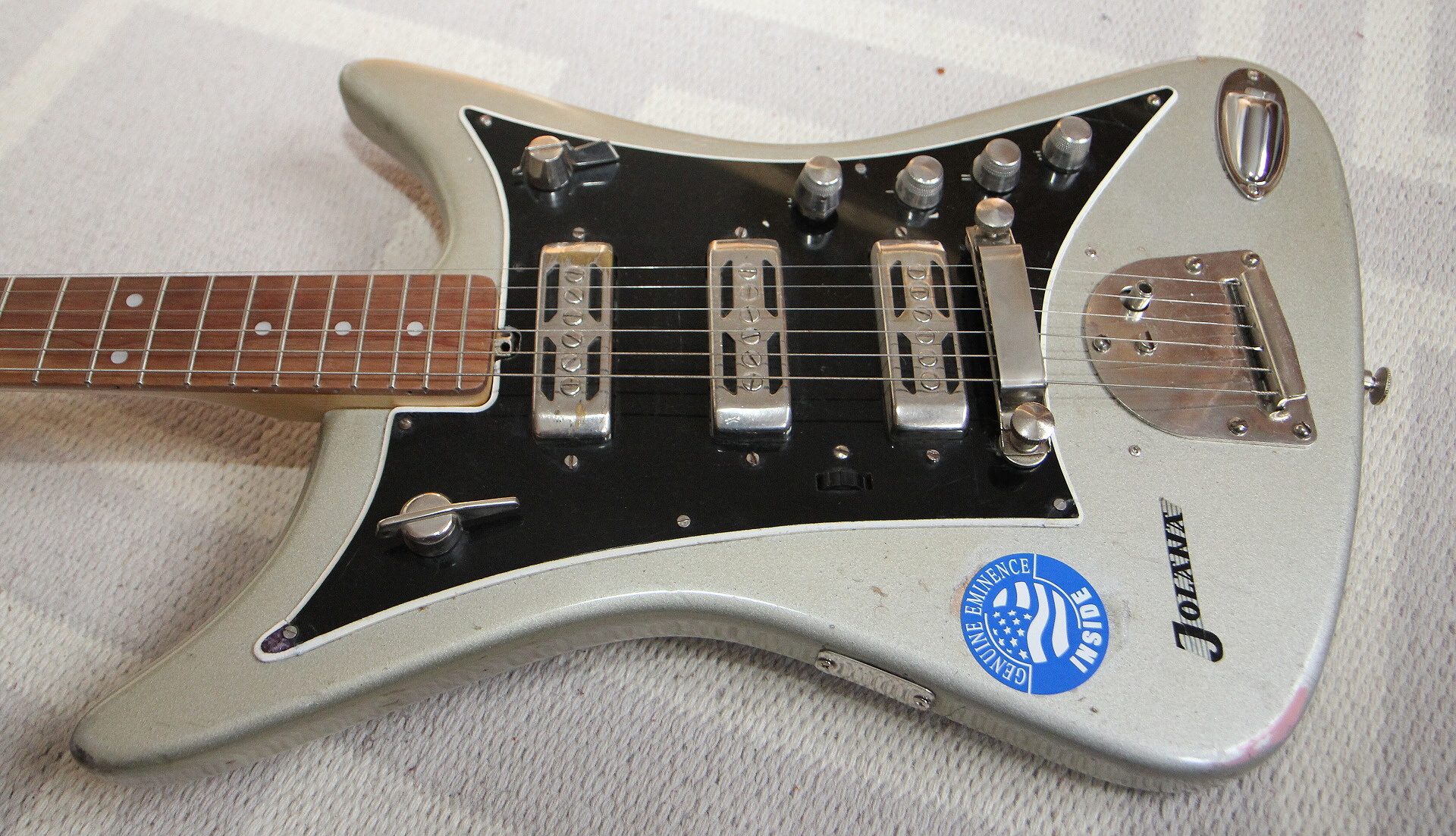
The Star X came with three single coil pickups with "toaster-like" covers. The guitar also had four potentiometers on the guitars lower side in a line. On the lower horn was a four way switch that says Tone. On the upper side of the guitar was a thumb wheel above the bridge and middle pickups..
Then on the upper horn was another four way switch that was the pickup selector. Once again the neck was maple with a rosewood fretboard that had dot position markers. The headstock on this instrument was pointy with three tuning keys on either side.
Basso X
The Basso X, which supposedly matched the guitar was in a totally different shape. This bass guitar had a similar offset bottom that sloped downward to a point. It also had two pickups that appear similar to Rickenbacker's toaster pickups. On the upper bout was a pickup selector switch and on the lower side there are 3 knobs that had pointers. The input jack resembld a Stratocaster jack.
Jolana Basso X
The metal bridge is covered with a hand rest and the strings are attached to a metal stop. Like the guitar, the bass neck was maple with a rosewood fretboard. This basses and the headstock was also pointy and had two tuning keys on either side.
Jolana Diamant
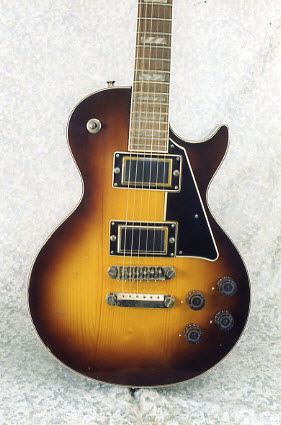
The Jolana Diamant was a Gibson copy of a Les Paul Custom. It had a bolt-on neck and aluminum nut, a zero fret and a four way rotary switch on the upper bout as well as twin single coil pickups. It even had a tune-o-matc style bridge with individual saddles and a stop tailpiece.
Jolana Diamant II
The most recent version, the Diamant II, emerged that had the same split diamond headstock inlay and headstock binding. The pickups on this second model resembled P-90’s. And the rotary switch on the Diamant II was replaced with a three way rotary switch. The logo that was inlaid in the headstock read “Diamant” in stylized script.
1983 Jolana Diamant II
Although the body of these two models appeared to be every bit of a Les Paul, their bodies were actually made of alder wood, with a beech plywood veneer. Later on, Jolana had installed their new Spektrum humbucker pickups in this guitar, but they did not come close to the sound of Gibson humbuckers.
Diamant Bass
But despite the criticism and comparison to a Les Paul, the Diamant was very popular throughout Europe.
The Diamant was sold for almost 20 years, right up until the company shut its doors.
Jolana Iris
Gibson was not the only company that Jolana copied. During the 1970’s the Jolana Iris was the company’s version of the Telecaster Thinline. Although it pails in comparison, it was probably not a bad guitar.
The Iris came with two angled single coil pickups, a metal bridge with a cover and what appeared to be a vibrato unit.
Jolana Iris
The earliest models sported single coil pickups with pole pieces, while the later models had single coil blade pickups. The Iris came bore a metal control plate that was very similar to the one on a Telecasters.
The Fender Stratocaster was also fair game so Jolana created the Galaxis. However the only thing that was copied was the body shape. This guitar came with two large humbucking pickups that had blades and were called Sapphirs by the company.
1981 Jolana Galaxis
The electronics of the Galaxis included twin volume and tone controls. The instruments strings passed over a metal bridge with a Jazzmaster style cover. The string were attached to a Jazzmaster style floating bridge.
Jolana Galaxis
The neck of the Galaxis was topped with a rosewood fretboard that was bound and had dot inlays. The headstock featured six-in-a-line tuning keys. Some headstocks were bare wood and some were painted to match the body. All of them bore a decal that said “Iris.”
By 1989 the communist regime ended and the national cooperative fell into disarray. The factories that kept workers busy stopped manufacturing or became privatized.
The factory in Horovice was renamed Delicia and manufactures stringed instruments.
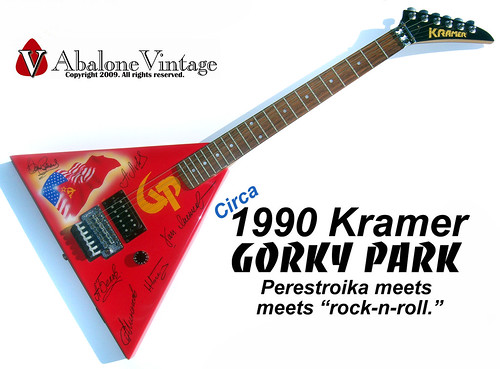
In these years of Perestroika they signed a deal with Kramer guitars and built the Gorky Park signature guitar that was shaped like a balalaika.
Czech made Epiphone
In the past Delicia also produced budget Gibson models under the Epiphone brand to be sold in the European market.
They restarted manufacturing electric guitars and basses under their own brand name.
And in the latter part of 2003, Delicia reintroduced the Jolana brand to the European market. These were updated versions of the old Jolana products that include the Tornado and the Diamant, however these instruments are totally modern and used sophisticated parts. Sadly the Jolana’s were discontinued in 2005.
Update Version of the Jolana Gracioso
As of November 2015 Jolana is back in business and manufacturing their guitars and basses in Horovice in the Czech Republic by a company called Bohemian Musico. These are now high quality instruments that use handwound or Seymour Duncan pickups, Schaller tuners and modern CNC technology. Check them out.









.JPG)