I started playing music when I was only 10 years old. My folks got a big old fire engine red upright piano from my Mom’s uncle. Dad had it hauled to our basement and I set out to take lessons from an old lady that live a quarter of a mile away.
I rode my bicycle to my teachers house and I learned Every Good Boy Does Fine and FACE, the difference between whole notes, half notes and quarter notes, the sharps and flats and the G and F clef. But all I really wanted to do was play music.
I toughed it out and got a clarinet, which was certainly more portable. I made numerous trips to Willis Music to buy more reeds, since I was forever chipping them. But I was only playing notes printed on a page and I doggone it wanted to PLAY music! You know, spontaneously and from the heart.
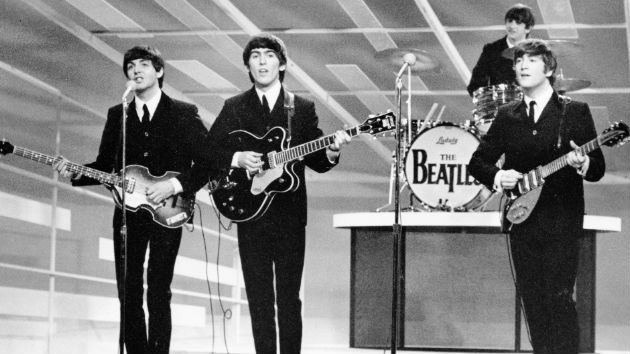
The Beatles came along which started a wave of other bands with young guys playing guitar and I surmised this may be the ticket. So I begged my folks to get me a guitar. I got one and then an electric guitar. Ever since then I’ve been playing music..from the heart.
That's me with a Strat at 14 years old
I spent my youth and now my senior years watching the guitar evolve, in the old days though the catalogs that usually arrived around Christmas time. Now we are in the Holiday Season so I thought it would be great to review those old days and pages and pages of the guitars that we longed for when we were young.
Harmony Guitars
Arguably one of the most prodigious producers of catalog guitar was the Harmony Musical Instrument Company of Chicago. Fender, Gibson, Guild, Martin and Epiphone were building high quality instruments, but in the 1960’s when the average annual income was less that $5,000, not many folks could afford a $400.00 guitar. But your parents could get a guitar and an amplifier from Sears or JC Penny’s for only $100.00. And it was great to look at the catalog and imagine this could be yours.
Kay Guitars
The other big manufacturer of guitars was Kay Musical Instruments, which was also based in Chicago. Some of their more expensive guitars may have been of a higher quality than Harmony, but all in all the two companies were fairly comparable. Like Harmony, Kay's biggest client was the catalog stores, such as Sears, Montgomery Wards, J.C. Penny and Western Auto. We waited every Christmas to decide which guitar would be the best.
Danelectro made Silvertones
Sears had the market on Danelectro guitars. These were inexpensively made out of formica, with wooden frames that came with single coil pickups which were housed in surplus lipstick tubes.
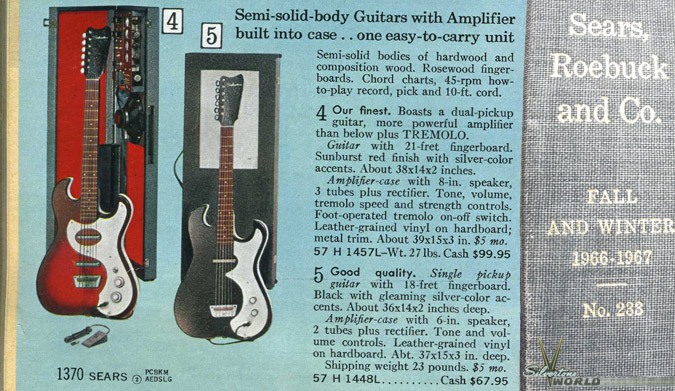
Sears Danelectro Silvertone with amp.
Instead of rosewood or mahogany sides, the sides were made of vinyl tape. You know what? Danelectro guitars hold up forever and back in the day they were used by many so studio musicians. Best of all they were cheap and stayed in tune. The Sears Wishbook was full of Danelectros with the Silvertone brand on them.
Silvertone guitar/amp-in-case
Plus Sears had a deal on a guitar and a case with the amplifier built into it. And in 1966 this could be yours for less than one-hundred dollars!
Montgomery Ward Airline guitars
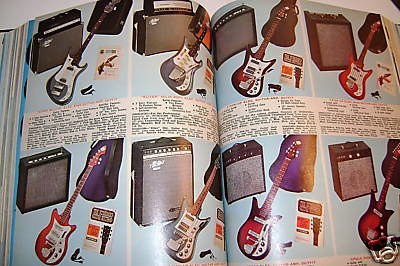
The other big catalog company was Montgomery Wards, or as some folks called them Monkey Wards, much like those of us today refer to Walmart as Wally World. Montgomery Wards distinguished their guitar line by mainly using a company called Valco Musical Instruments. This company sprung from the National Guitar Company.
Montgomery Ward called their house brand Airline guitars. Many of these guitars were made of Res-O-Glas, which was actually two shells of molded fiberglass that were sandwiched together with the electronics inside. The necks were made of wood. They were certainly more expensive than Danelectro guitars but were well made and came in a variety of “space-age” shapes and colors including one guitar that resembled a map of the United States.
Teisco brokers catalog
So maybe your folks were unable to afford that $100 Silvertone guitar and amp. You could have just as much fun playing an Asian imported guitar. And by the mid 1960’s the market was flooded with them. The biggest importer was Teisco of Japan.
They really weren’t so bad and they were continually improving. Why even Wrecking Crew member Glen Campbell did a lot of studio work using his Teisco guitar. These were featured in all the popular mail-order catalogs.
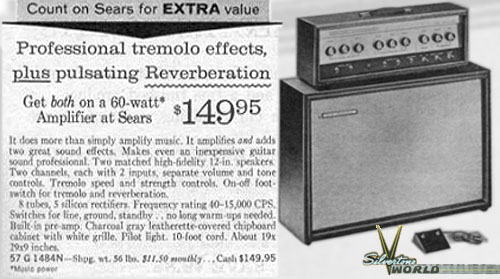
Silvertone amplifier
We haven’t even mentioned amplifiers. The biggest catalog jobbers of amplifiers were Danelectro and Valco. Before transistors came along, you could get an amplifier that worked with vacuum tubes at a reasonable price.
Montgomery Wards/Valco amps
The cabinets may not have been as nice as those Fender and Gibson were building, but these were nice amplifiers that ranged from 3 watts up to 100 watts and all you had to do was send in your money to Sears or Montgomery Wards and wait for the post man.
Things are so much different these days. Life has changed.
We don’t have to wait until the Holiday Season for the catalog since we can log into Musicians Friend or Guitar Center or our local music stores web sites to see what is being offered. Much of the merchandise is no longer built in the United States, but the World’s manufacturers have come a long way in improving their products and in many cases their offerings are of excellent quality.
I wish all of you a very Merry Christmas and a Happy Holiday Season and a Prosperous and Blessed New Year! And may this year bring Peace on Earth!
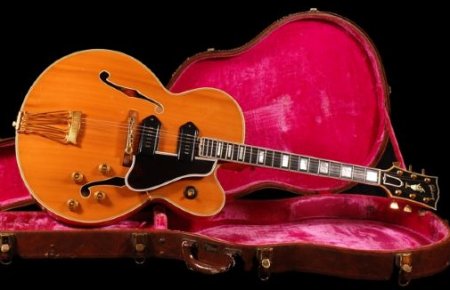
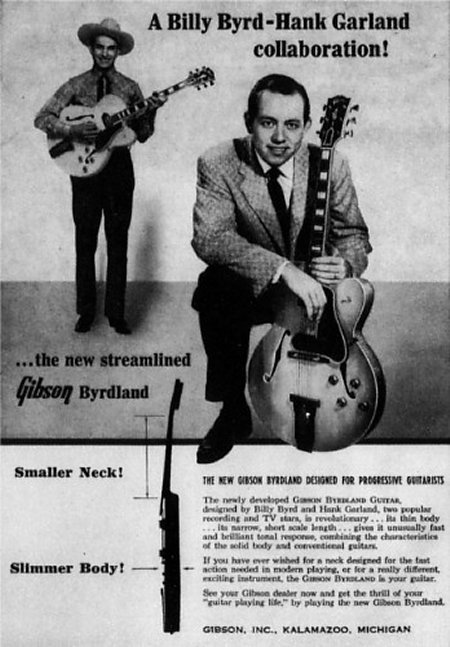
The Byrdland is a stunning looking electric guitar that is made by Gibson. Its name derives from the names of guitarists Billy Byrd and Hank Garland for whom Gibson originally custom built the guitar.
At the time Gibson's president, Ted McCarty, sought opinions and ideas about new products. So in 1955, in collaboration with two of the best Nashville guitars on the scene, Billy Byrd and Hank Garland, Gibson developed the Byrdland guitar.
The Byrdland was the first of Gibson's Thinline series. Many guitarists did not desire the bulk of a traditional archtop guitar such as Gibson's L-5 CES, one of Gibson’s top models. The Byrdland was built with its overall depth of 2¼ inches which,was over one inch shallower the Gibson's L-5 CES model.
It was later during the design process, Byrd and Garland specified a shorter scale neck.which would help facilitate intricate single-note patterns and unusual stretched chord voicings.
Billy Byrd
Only three were produced in 1955.. Billy got number one and Hank got number two and then he ordered and purchased a third that had a custom cherry finish. At this time the two prototypes both had natural finishes and Venetian cutaways.
The original instruments were to come with twin Gibson P90 single coil pickups. Although Hank ordered his with a single P90 and a Charlie Christian pickup in the neck position.
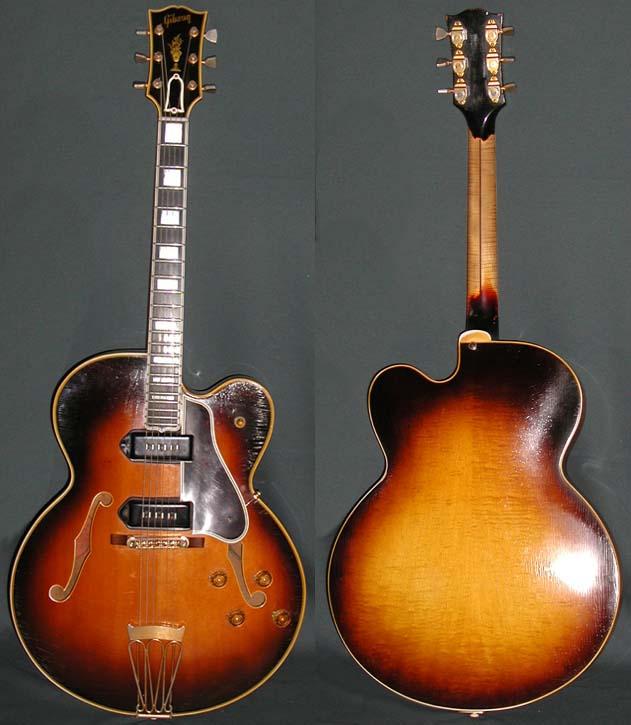
1957 Byrdland
This guitar was designed with jazz players in mind. It featured the same 17” wide, 21” long spruce top and body as was on the single cutaway L-5 CES, but the body was shallow. In comparison, the Byrdlands body was only 2 1/4” deep as opposed to the full 3 3/8” body of an L-5.
The production models were equipped with Alnico V pickups. One interesting feature of this guitar is the fact that the two pickups are spaced closer together, because of the shorter scale and the 22 fret neck.
This gives the the Byrdland it’s distinctive sound. In later years the Alnicos were replaced with humbucking pickups.
The headstock and the neck were both bound. The ebony fretboard came with block mother-of-pearl position markers which started at the first fret. The headstock featured the traditional Gibson flower pot inlay.
The Byrdland came with a fancy gold-plated trapeze tail piece that was engraved with Byrdland and the rosewood bridge with topped with a Gibson tune-o-matic saddle. The body was bound as were the guitars F holes.
Hank's #2
Hank Garland’s number two and number three Byrdlands both had fancy three loop trapeze tailpieces that were gold plated. Number two had the Charile Christian pickup with a white top plate, which matched the guitars while pearloid pickguard, while number 3 had a black top plate on the pickup. In the following year,
By 1956, Gibson sold 60 units, which was more than the combined sales of L-5’s and Super 400’s. Electric guitarists seemed to appreciate the feel of the narrow body.
The number 3 Byrdland was the guitar that Hank played at the famous Elvis concert in Tuepelo Mississippi in 1957. This was during a period when Scotty Moore and Bill Black had quit the band.
Hank's number 3
Hanks number three was given back to Gibson in 1957 and was supposed to be archived, however someone mistakenly sold it to a music store in Chattanooga Tennessee. A music teacher there purchased it and had it autographed by Hank Garland.
The Byrdland then became a regular production instrument. Later Gibson developed the ES-350T from the Byrdland using less-costly hardware and detailing, and offered it as a less expensive model.
From 1955 to 1960, Gibson made the Byrdland with a Venetian, or rounded, cutaway.
1961 Byrdland
From 1961 to 1968, it used the sharp, pointed, Florentine cutaway.
It returned to the Venetian in 1969. The model was in production from 1955 through 1969.
1978 Byrdland
Gibson reintroduced it as a limited run in 1977, 1978 and 1992.
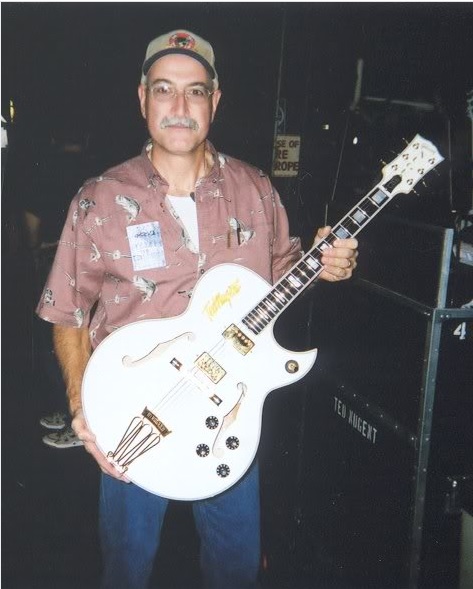
In the late 1960s, guitarist Ted Nugent began using a Byrdland, which was unusual considering Nugent's style of music.However, in an interview Nugent states that he first saw Detroit guitarist Jimmy McCarty playing a Byrdland back in the early 1960's.
Nugent was amazed at McCarty's ability as a player. At the time Nugent was in a rock band and was the opening act for McCarty's band. McCarty was playing a Byrdland through a Fender Twin amp. Nugent finally saw a Byrdland for sale at a local music store he frequented and was able to trade his Epiphone Casino and a few hundred bucks for that guitar. He has been collecting and playing Byrdlands ever since then.
Nugent's Great White Buffalo Model
The hollow-bodied nature of the guitar created feedback issues at higher levels of gain and volume, making it impractical for hard rock and similar styles. Nugent incorporated the controlled feedback of the Byrdland into his playing and continues to use it today. Nugent gives his Byrdlands, and other Gibsons, a custom touch by removing the stock selector switch knobs, and installing Gretsch strap-lock knobs.
When the instrument was first introduced in the Gibson Guitar catalog, the famous jazz club, Birdland, filed a lawsuit against Gibson over the name. The court dismissed the suit when Gibson showed that the name was made up from the names of two people.
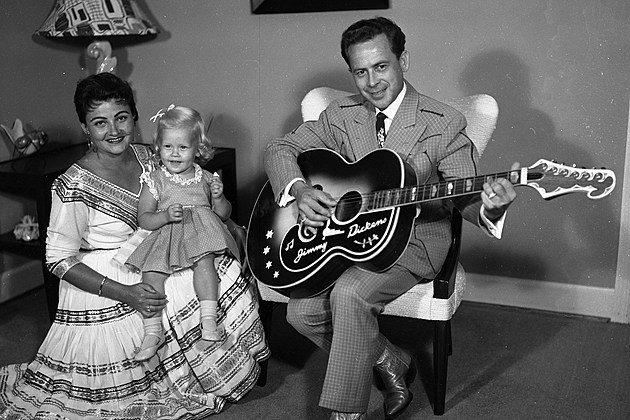
Little Jimmy Dickens began his musical career as a teenager in the late 1930’s under the pseudonym, Jimmy the Kid. He was hired at a radio station in Saginaw Michigan that was owned by another well-known Country artist, Roy Acuff. Acuff introduced him to his people at Columbia Records and due to his short stature began using the name LIttle Jimmy Dickens.
In 1950 his band included some amazing studio players such as Jabbo Arrington, Grady Martin, Bob Moore and Thumbs Carlile. It was Dickens who discovered Marty Robbins during his bands tour.
Though Dickens had many Country hits, he scored his first number one hit on the Country chart and on the Pop chart with his 1965 novelty song, “May the Bird of Paradise Fly Up Your Nose.”
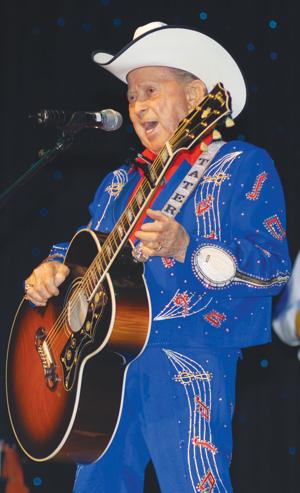
Jimmy was well known for his flashy “Nudie” suits and guitars that looked too big for him.
I can recall a story he once told about a tour bus that pulled up in front of his Nashville home. He was mowing his grass when several tourists asked him if he liked working for Mr. Dickens. He replied, “Heck yeah. He’s a swell guy.”
Memorial for Jimmy Dickens
Dickens was hospitalized after suffering a stroke in late 2014 after his last Grand Ol’ Opry appearance. Several weeks later in January of 2015 he passed away at age 94.
I just received word that the guitar collection from the Estate of LIttle Jimmy Dickens in on display and for sale at Gruhn Guitars in Nashville.
This collection features many instruments that Dickens used through the early part of his career and includes a guitar presented to him by George Jones, which is autographed by Jones.
There is also a custom guitar built by luthier Glen Morgan out of wood that was once a pine fence which stood in the back of Dickens’ property. Additionally there is a Rich & Taylor Jumbo model that includes a red sparkle hard shell case with “Jimmy Dickens” hand painted on top of the case.
Mr. George Gruhn states that he feels honored to help find new homes for these wonderful instruments. The asking prices are very reasonable.
Incidentally all photos used for this article are from Gruhn Guitars. If you are interested the phone number is 615-256-2033.
This 1982 Martin D-41, the top is autographed by George Jones comes with letter from Dickens stating that the guitar was presented to him by George Jones on September 21, 2006. Guitar comes with a hard case. Priced at $15,000.00
The next is a 2001 Martin Grand Ole Opry. This is number #158 of 160. It comes with the original hard case. Priced at $5,000.00 2009
This Martin D-16 Ryman model NM, peghead veneer, fingerboard inlays and pickguard made from original Ryman pews. It is a limited edition #40, It, comes with letter from Jimmy stating that it was a gift to him from Brad Paisley on his 90th birthday, It too comes with a hard case. Priced at.$5,000.00
This 1942 Martin 00-18 is in very good condition. It has extensive playing wear but is structurally solid. It has a replacement bridge and tuners, neck professionally reset. This guitar has great provenance as it was Jimmy Dickens' first good quality instrument and used extensively during the early part of his career. Priced at $15,000.00 and comes with a hard case.
This gorgeous 1986 Gibson J-200 90th Anniversary is in very good condition. It comes with rhinestone studded strap embroidered with "Tater". It also comes with a hard case and is priced at $15,000.00.
Jimmy Dickens' 1964 Gibson B-25-12 is in very good condition and comes with letter from Dickens stating that he purchased it from Benny Birchfield - Jean Shepard's husband, Priced at only $6,000.00 with a hard case.
The next is a 1940 Gibson J-100 neck that has its dimensions cut down. The peghead veneer has been replaced, as was thepickguard, and bridge,This guitar has been refinished, Little Jimmy Dickens, used this instrument extensively throughout his career. It comes with letter from Dickens stating that guitar was remodeled by luthier Bill Merritt in the 1970s, It also comes with a hard case and is priced at $15,000.00.
This beautiful 1994 Rich & Taylor 17" Jumbo is in excellent EXC (minor lacquer checking), custom built by Rich and Taylor for Mac Yasuda to be presented to Little Jimmy Dickens. It has a spruce top, Brazilian rosewood back and sides, ebony fingerboard with tree of life pearl engraved inlay, pearl inlay pickguard featuring eagle and Jimmy Dickens' name, white binding on fingerboard and body, gold sparkle trim on all body edges, red sparkle HC with "Jimmy Dickens" hand painted on top. It comes with a hard case and is priced at.$20,000.00.
This First Act autographed acoustic comes with a top that has been autographed by Jimmy Dickens, Patty Loveless, Jimmy C. Newman, Porter Wagoner, John Anderson, Jeanie Seely, Bill Anderson, Barbara Mandrell, Connie Smith, Jeannie Pruett, Jim Ed Brown, Billy Walker, Jack Greene, John Conlee, Vince Gill, Big Al Downing, Patty Loveless, Buddy Jewell, and Ricky Skaggs. It comes with a hard case and is priced at.$1,500.00.
The next is a 2012 Glen Morgan Custom Little Jimmy Dickens Model that is in very, very good condition. It has some minor lacquer checking, Ii has a 17-3/4" body width and comes with a hard case. It is priced as only $3,500.00.
This guitar is a 2012 Glen Morgan Custom 'Tater' Little Jimmy Dickens 001 and is excellent condition. Itcomes with letter of authenticity from Dickens and Morgan stating that it was manufactured from the pine fence which stood for years in the back of Jimmy's property. The guitar comes with a padded gig bag and is priced at $3,500.00.
The one of a kind is a 1980 Danny Ferrington Custom that is in very good condition. It was damages from 2010 Nashville flood and restored by luthier Danny Ferrington.,The provenance of this guitar is based on the fact that it was presented to Jimmy by Waylon Jennings. The guitars top is engraved in pearl inlay that reads "JIMMY, You're a Hell of a Man -WAYLON". It is priced at $20,000.00.
This 1923 Gibson L-3 is in good condition. It was repaired from water damage casued from the Nashville flood of 2010, It comes with a modern Gibson hard case and is priced at $3,500.00.
The final offering is a 1970 Lotus electric that is in very good condition. It features leather tooling on the top and sides that were created by the Yarbrough Saddlery of Las Cruces, NM and it comes with letter from Dickens stating that it was owned by his brother Dewey, This instrument comes with a hard case and is priced at $2,500.00