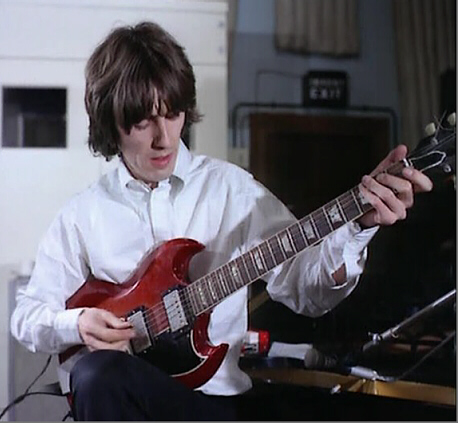
Beatles' guitar sold for £294,000 A guitar played by George Harrison and John Lennon has fetched £294,000 ($570,000) at auction in New York.
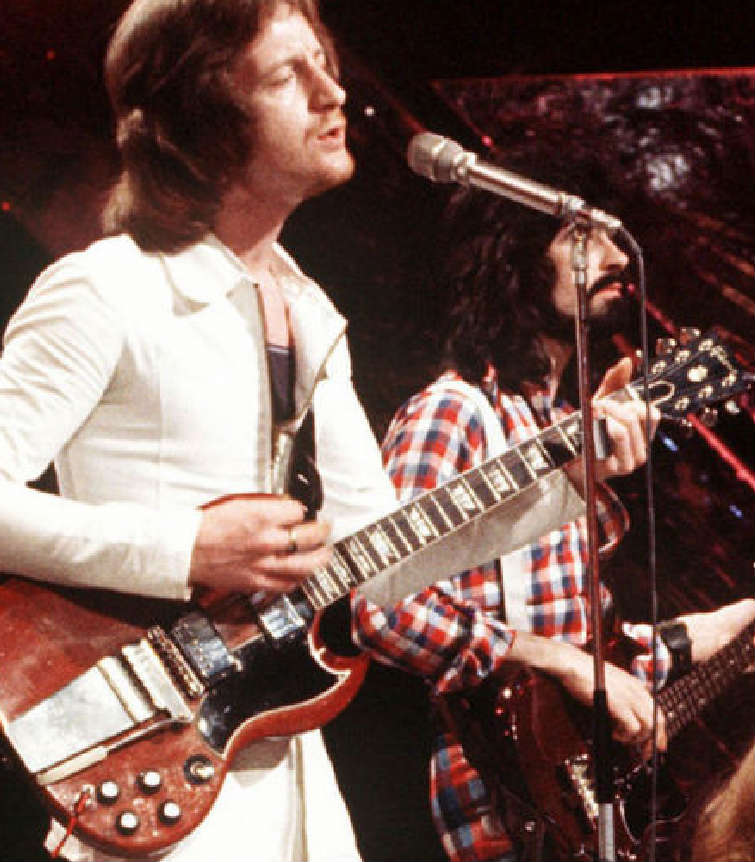
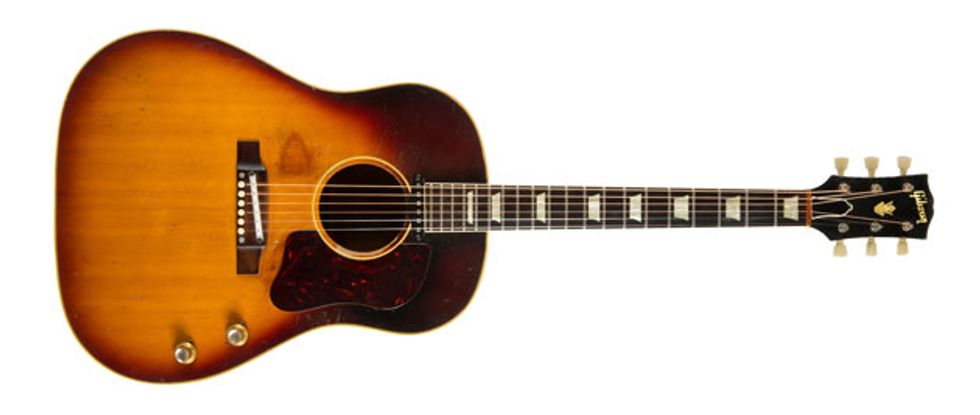
The Gibson SG guitar was used by Harrison from 1966 to 1969, including during the recording of Revolver, and by Lennon during White Album sessions.
Pete Ham with SG
George Harrison had given the Gibson guitar to Peter Ham - of the rock band Badfinger in 1969. When Ham died in 1974, it was stored away by his brother and not rediscovered until the US Rock and Roll Hall of Fame contacted him in preparation for a Badfinger retrospective in 2002.
It sold to an anonymous bidder on Friday. Among 70 items of Beatles memorabilia on auction, there were also never-before-heard original tapes of an interview of Lennon by a reporter for the Washington Star newspaper from 1975. These sold for £27,900 ($54,100).
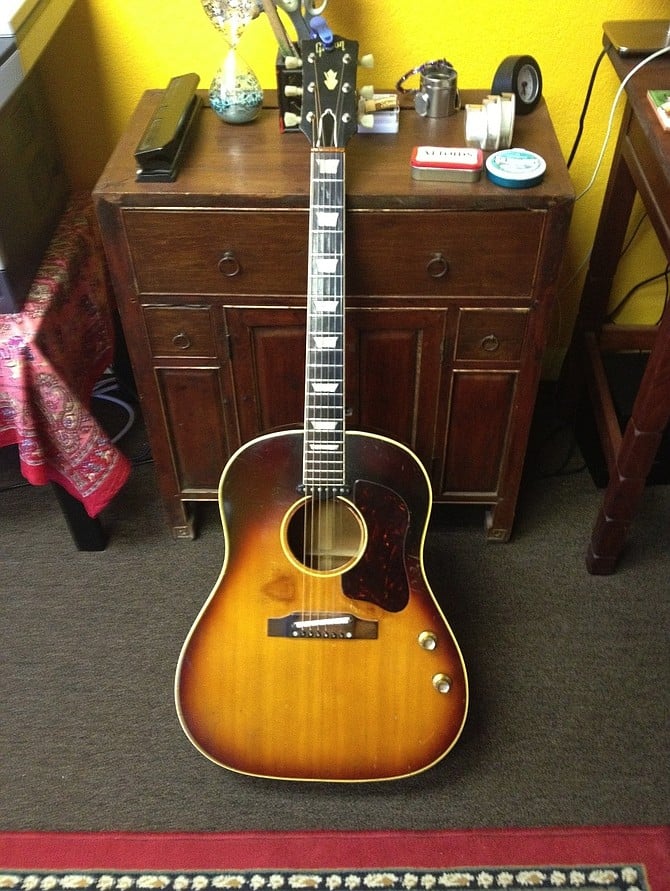
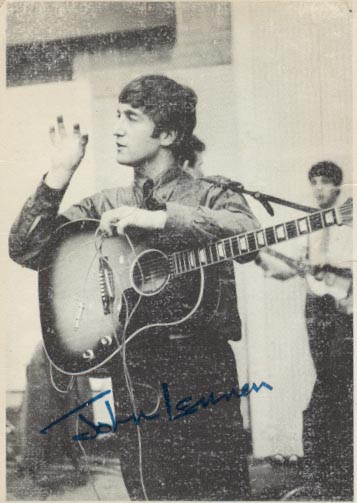
John Lennon’s 1962 Gibson J160e guitar, once thought lost, has been discovered in San Diego at Marc Intravaia’s Sanctuary Art and Music Studio in Sorrento Valley and is about to go up for one of the most publicized auctions in Beatles history. However, “Once the story broke on Reuters, there was quite a few awful comments about my friend [John McCaw, the guitar’s owner] from people not knowing the whole story,” Mr. Intravaia tells the San Diego Reader.
“He bought it in 1969 from a friend and never knew what he had until he brought it to me last August.” John McCaw, who bought the guitar from a friend in 1969 for $175, never knew what he had. McCaw bought the mildly beat-up Gibson acoustic from a friend for $175, in a transaction at Blue Guitar shop, then located in Old Town.
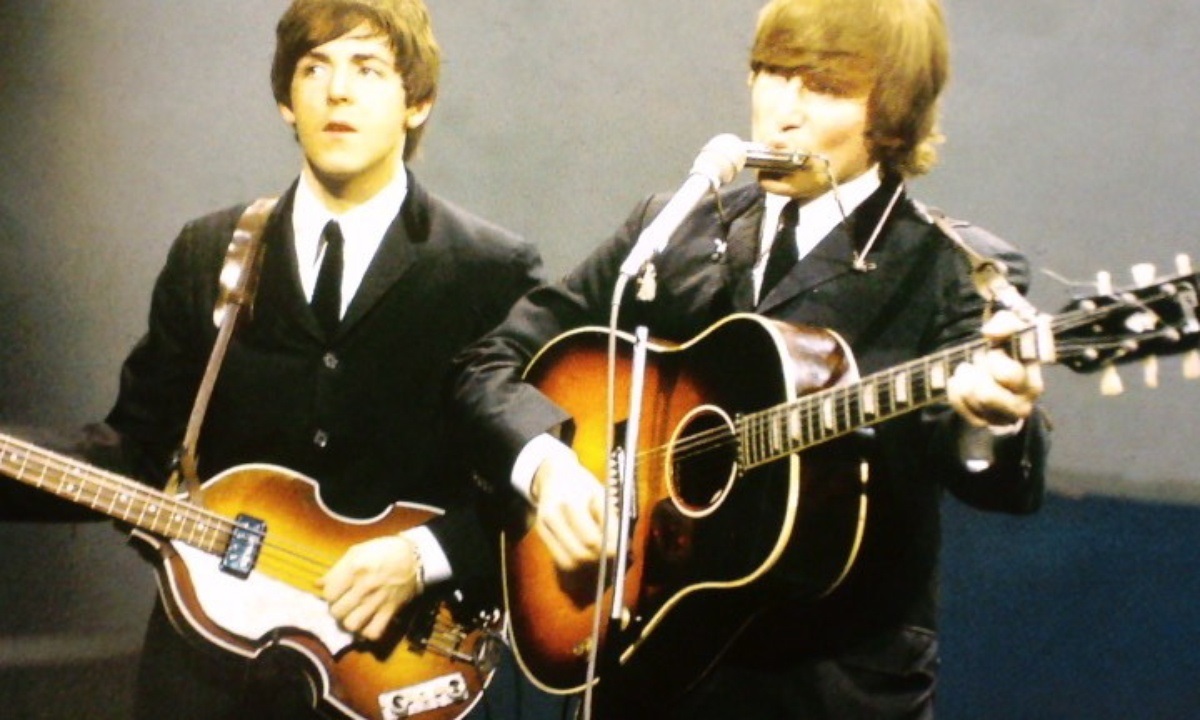
After spotting a magazine article in 2014 with a photo of George Harrison holding a similar guitar, McCaw noted Harrison’s guitar was only four serial numbers away from his Gibson, and concluded they were probably made on the same day in 1962. Further research revealed that John and George bought identical Gibsons on September 9, 1962 at a Liverpool music store called Rushworth’s.
“He had read that at some point between September 1962 and December 1963, they swapped instruments for reasons unknown,” says Intravaia, “and that John’s guitar went missing after a series of December 1963 Christmas shows in London at the Astoria Cinema in Finsbury Park.”
Marc Intravaia and McCaw found video of Lennon playing the guitar and noted several remarkable similarities to McCaw’s guitar, too numerous and detailed to list here but including specific scratches, wear marks, and – most telling – wood grain patterns.
Local video archive licensors Reelin’ in the Years provided a high-def tape with freeze-frame close-ups of Lennon’s guitar, and pairing it with footage of McCaw’s (as seen in a new YouTube video) led to Intravaia contacting the official Beatles gear expert Andy Babiuk.
“He made it very clear that this might be a forgery and that he needed better pictures of the wood grain, because, in his words, ‘the wood grain is the DNA of the guitar.’
” With Babiuk holding all the original records and receipts for Lennon and Harrison’s Rushworth’s guitar purchases, Intravaia was delighted when “I received a call from Andy confirming that it was John Lennon’s guitar.”
Julien’s Auction House in Beverly Hills is auctioning the Gibson over the first weekend of November. The company’s owner, Darren Julien, calls it “one of biggest finds in music history,” stating in the press release that its sale may exceed the $965,000 earned in 2013 for an electric guitar owned by Bob Dylan.
Korean based Samick Musical Instruments Co, Ltd. is one of the world’s largest producers of musical instruments.
1960's Samick bass
You may be playing an instrument made by the Samick factory and do not know it. With a manufacturing capability of more than one million guitars per year in factories in Korea, Indonesia, China, and the United States, Samick also ranks as the world's leading stringed instrument producer.
The company sells its guitars under its own brand names, including Samick, Abilene, Silvertone, and the Greg Bennett Signature Series.
Samick has manufactured guitars for many other companies, including Fender and Gibson.
Additionally, this manufacturer produces a full range of pianos, electric and acoustic guitars, basses, banjos, autoharps, harmonicas, and other instruments. It also operates a dedicated Upright Piano and Piano Action plant, as well as its own sawmill and woodworking facility in Korea, a smaller factory in California, and a plant in Harbin, China that produces wooden guitar and piano parts.
Samick was started in 1958 with the goal of enriching human life through music, the universal language. Hyo Ick Lee founded the company as an importer of Baldwin pianos to Korea. Within two years Samick began building their own upright pianos, using imported parts.
In 1965, during the Folk Music years and the British Invasion years, when every kid wanted a guitar, Samick began production of acoustic guitars for the Korean market as well as for export to fulfill the demand for cheap Asian-made guitars that overwhelmed the market during this decade.
Samicks goal was toward a higher quality market. The company continued to improve its piano manufacturing techniques, and in 1970 its production abilities had developed sufficiently for it to launch its first grand pianos.
Hondo Guitar
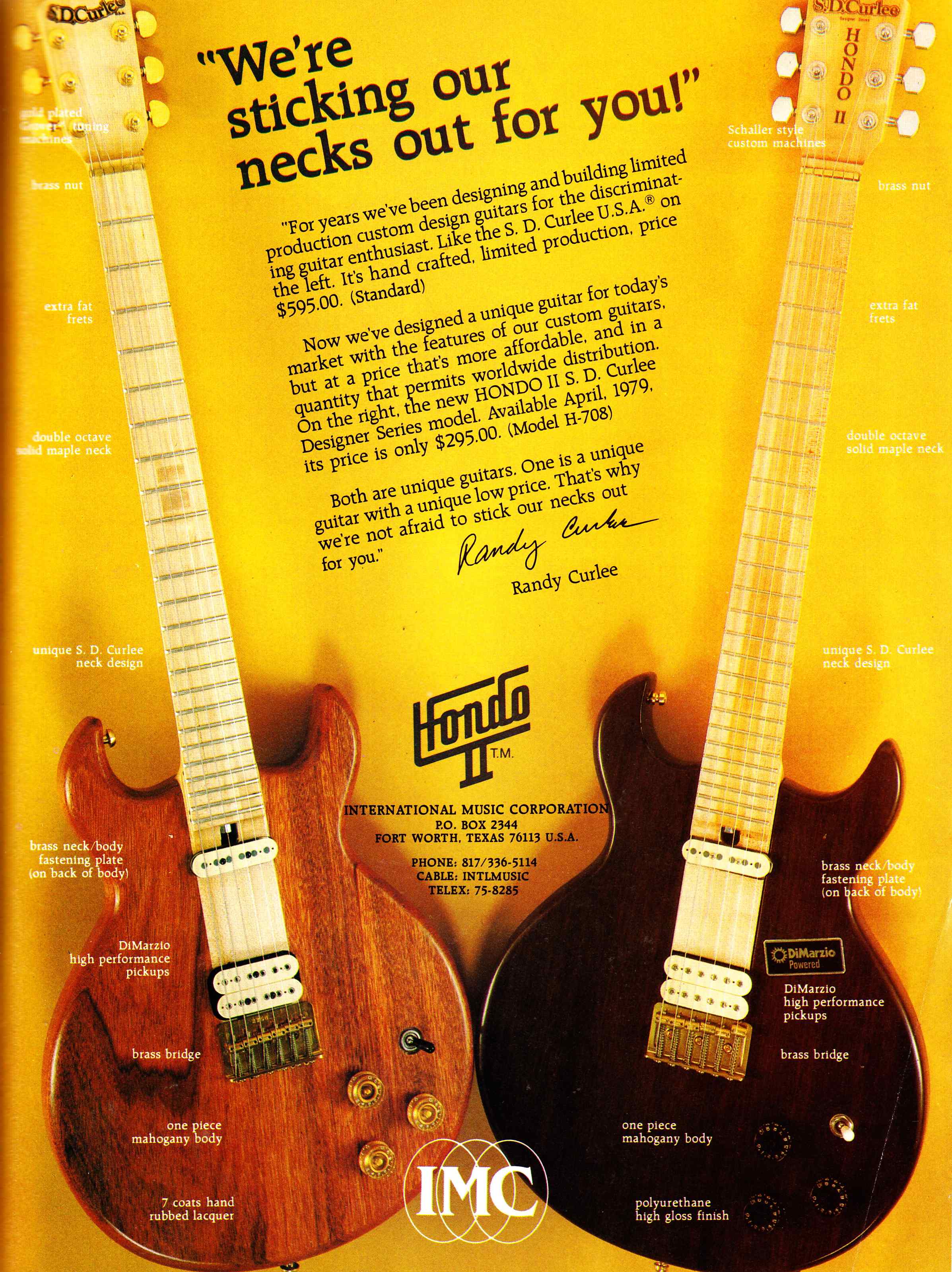
During this same period, the company began to step up the quality of its guitar production. Samick formed a joint venture with Texas-based International Music Company (also known as the Hondo Guitar Company).
Hondo II SD Curlee
The new company introduced modern U.S. production methods to the Korean market, while taking advantage of the low-wage level in Korea to offer inexpensive, entry-level guitars. Hondo initially produced a line of classical and folk guitars. By 1974 the company’s electric guitars had gained a level of quality and became one of the largest selling entry level brands. Hondo added banjos and autoharps to their product line up. By the end of this decade Hondo was selling nearly 800,000 instruments per year.
In 1971 Samick introduced a line of harmonicas.
And in 1973 Samick was diversified in its production and changed its name to the Samick Musical Instruments Mfg. Co. Samick’s thrust was the export market, especially the United States. To facilitate this, a branch office was opened in 1978 in Los Angeles California.
The lower production costs of Korean-manufactured instrument made them attractive to entry level buyers. This was especially true in the piano market since costs of US made pianos had escalated. In fact in 1979, Samick was building the Schumann piano brand for US households. During these years, the Korean musical instrument industry had caught up to its primary competition, Japan, and due to lower construction cost had surpassed them.
In 1979 Samick had developed new automated production facilities that reduced the need for skilled employees and increased production with the benefit of maintaining quality standards.
By 1982 Samick opened a branch office in Germany to introduce their brand to the European market. That same year they established a full U.S. subsidiary known as Samick Music Corporation. In 1988 Samick went public, listing shares on the Seoul stock exchange.
That same year they purchased the Kohler and Campbell piano brand. The company had claimed the number one spot for grand piano sales by the end of 1995.
Faced with economic issues in Korea and most of Asia, in 1996 the company filed for bankruptcy protection.
The company had become too diversified with investments in furniture, computers, industrial equipment and the fishing industry; they were unable to make a profit and had a debt of nearly $10 million.
Samick’s prominence as a musical instrument manufacturer was a key factor that saved the company from going under. The company was able to rid themselves of non-profitable business ventures and most of its debt to the point they were able to begin reporting profits. In 2000 the company had a contract with OEM (original equipment manufacturers) for $50 million to supply grand pianos to Baldwin pianos. They gained another plus when the acquired Knabe pianos that same year.
In 2002 a consortium of Korean businessmen acquired Samick and retired all of its debt. Kim Jong-sup became president and announced the goal of becoming the Worlds Top Piano Brand. By April 2003, Samick with a revenue growth of nearly 30 percent, it pushed past the $200 million mark.
With the launch of a new line of high-end Knabe-branded pianos, Samick was prepared to claim a place among the world's leading quality piano makers in the new century.
Since the days of “lawsuit” guitars, Gibson and Fender both made the decision, if you can beat ‘em, join ‘em. Both companies have outsourced manufacturing of their “shadow” brands; Epiphone and Squier, to Asian manufacturers. It is difficult to determine where these brands originated. But it is a good guess that many of the superior, high-end guitars from were made by Samick in accordance with Gibson or Fender standards of quality.
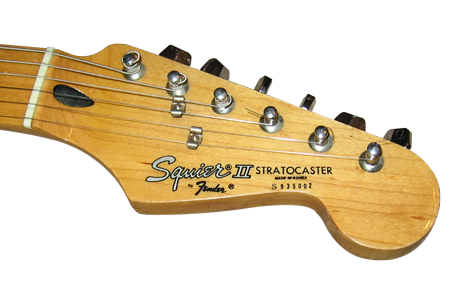
The Squier brand was developed in 1982 and early on all production was based in Japan. The first Squier guitars to emerge from Korea started as early as 1986. You can determine if your Squier was made by Samick was through its serial number that began with an “S” or “S9” followed by six digits. Samick began production of Squiers in 1989.
M-72
In the 1990’s Fender had acquired the DeArmond brand name. Initially this brand was introduced in Europe. In the late 1990’s, Fender offered DeArmond guitars for sale in the United States.
DeArmond Starfire
DeArmond guitars were based on Guild electric guitars that were no longer in production. The DeArmonds made in Korea were produced by Samick and perhaps Cort.
They are excellent quality instruments that come with reproductions of DeArmond 2K or Goldtone pickups.
Your DeArmond will have a sticker on the back of the head stock noting if it was made in Korea or Indonesia. In 1983 Epiphones were mainly manufactured in Korea.
By 1986 Gibson Guitars was acquired by Harvard MBAs, Henry Juszkiewicz, David Berryman and Gary Zebrowski, bought Gibson/Epiphone from ECL/Norlin. The new owners recognized the importance of the Epiphone brand and how the company could be pushed to match the success of other Asian guitar brands.
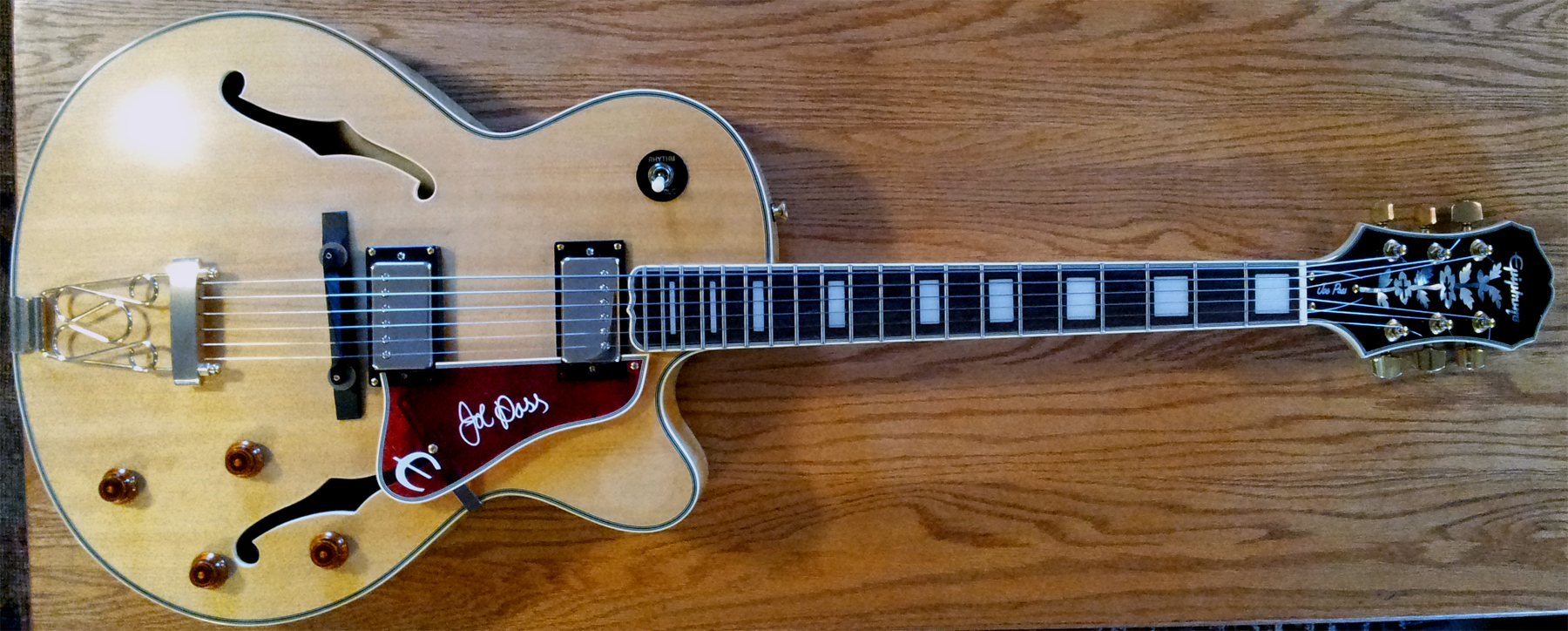
Samick built Epiphone Joe Pass
During this era, the new owners of Gibson opened up an office in Seoul to watch over manufacturing of their products. Not all Epiphones were manufactured by Samick. Factory processes were assessed and refined and Epiphones own engineers took a hands-on role in the development of pickups, bridges, toggle switches, and fret inlays, as well as unique features like the metal E logo and frequensator tailpiece.
These Epiphone guitars were constructed using different woods, for example Nato instead of Mahogany. Bodies were fastened with epoxies instead of wood-glue. Finishes tended to be polyester resin instead of nitro-cellulose lacquer. Some parts are made of plastic, such as nuts and bridge saddles instead of bone. Cheaper hardware and pickups were sometime used.
In 2002 Gibson moved all of its Epiphone production to Qingdoa, China.
One method of determining if your Epiphone guitar was made by Samick is its serial number. There may or may not be a factory code. There may be no factory designator for some models made in 1993 and earlier years.
Like Epiphones, Samick instruments generally start with an “S”. For example S3021234 is indicative of Samick-S-1993-3-February-02-unit 1234. If it begins with SI, that means it was made by Samick in there Indonesian plant.
In 1926 Gibson introduced the L-0 acoustic flat top guitar. The top was amber stained spruce. The back and sides were made of birch that had been stained in a brown finish. The Gibson L-0 was a small guitar measuring only 13 ½” wide across the lower bout. The top and back of the body were bound.
The unbound neck came with a fretboard was made of “wood” that was “ebonized” or stained black. On the 5th, 7tn and 9th frets were white dot inlays. The Gibson logo, painted in white, adorned the head stock. The tuners were 3 on a side plate style with white or black buttons.
This guitar had an ebony “belly” bridge with pins securing the strings. The neck joined the body at the 12th fret. There was no pickguard on this model. The guitar retailed for $35.00 USD
This was one of Gibson’s cheaper guitars and it was very lightly constructed. The interior revealed ladder bracing. The player had to use light gauge strings, because heavy string would ruin the guitar.
Guitars in the L series were very popular with Blues players and fingerpickers due to their upper and mid range timbre and price point.
1928 L-0
Changes occurred in 1928 to this model. The top was now made of mahogany as were the back and sides. The belly bridges on some of these guitars had an extra white bridge pin below the six black ones. No reason is given, except it possibly was just a spare bridge pin. The fretboard was still unbound but it was now made of rosewood.
1929 L-0
By 1929 the bridge was changed to a flat style without a belly and the extra bridge pin was phased out.
In 1930 to 1931 the body was widened to 14 ¾” on the lower bout (exactly the same shape as the Gibson L-2). The shape of the guitar was changed from a rounded bottom style. The bottom of the body was more of a square shape. The bridge was made of a rosewood rectangle with an angled saddle.
The top, back and sides were all made of mahogany. The rosewood fretboard was unbound and had dot inlays on the 3rd, 5th, 7th, 9th, 12th and 15th frets. The same 3 on-a-side tuners were used.
1932 L-0
The big change in 1932 was that the neck joined the body at the 14th fret. In this year the guitar was now available in a natural finish for an upcharge. The logo continued to be painted on with white paint. The L-0 was discontinued in 1933 but revived four years later in 1937. The specs remained similar but for the top which was now made of spruce and painted black. The 1937 version of the L-0 guitar came with a fire-striped tortoise grain pickguard. The price was reduced to $25.00 USD. By 1942, the L-0 was officially discontinued.
1926 L-1
The Gibson L-1 was said to be the choice of Blues legend Robert Johnson. This was originally an archtop guitar, but in 1926 it was re-introduced as a flattop. It was more expensive and the materials were of better quality than the original L-0 model.
The 1926 version included the small body with a 13 ½” span at the lower bout. The end of the body was elongated and rounded as was the style of the day. This guitar had a slightly arched spruce top that was stained amber. However some models did come with a natural finish.
The rosette around the sound hole was fancier than that of the L-0 with 3 consecutive black rings with white rings between them. The back had a slight carve and was made of birch as was the guitars sides. These were stained brown.
1926 L-1
The fretboard was made of ebony and had white dot inlays between the 5th, 7th and 9th frets. The bridge was also made of ebony wood with carved pyramids at either end and was fitted with six black pins. The bracing pattern for the L-1 could be ladder braced, X braced or A braced. (Style A bracing is a variation on X bracing in which the X shaped struts are retained but the transverse strut between the fingerboard and the soundhole is replaced with 2 diagonal braces that splay outward toward the soundhole.)
The Gibson logo was painted in white on the head stock. The tuners were 3-on-a-side plate models. This list price for the L-1 was $50.00 USD.
1928 L-1
In 1928 some changes occurred to this instrument. The body size remained the same, but the spruce top now had a stained and shaded finish. The back and sides were now made of mahogany with a brown stain. The bridge was changed to rosewood and had a bottom bellow with a raised center. The neck on this model was bound and the fingerboard was made of rosewood with position inlay makers at the 5th, 7th, 9th, 12th and 15th frets. The tuners remained similar to those on the 1926 version. The neck joined the body at the 12th fret and the guitars scale was 25”.
The only change in 1929 was the addition of an extra bridge pin, though some 1928 model, like the one pictured, had this feature. Some models made later in that year had a rectangular rosewood bridge.
1930 L-1 catalog
By 1930 the guitars width was increased to 14 ¾” across the lower bout. The guitars top was still made of spruce with a stained and shaded finish. The back and sides were mahogany with a brown stain and were bound on the top and bottom. The bridge was slightly longer and was rectangular. The neck was once again unbound and had dot inlay position markers on the rosewood fret board at the 5th, 7th, 9th, 12th and 15th frets. In 1932 the specification changed. The neck now joined the body at the 14th fret.
1930 L-1
The scale was reduced to 24 ¾”. The body was no longer stained, but sprayed with a sunburst finish. The neck was once again unbound with dot inlay position markers at the 5th, 7th, 9th, 12th and 15th frets. The tuners were upgraded to individual Gibson style tuners.
Despite the improvements, the price was dropped from $50.00 to $37.50. These were the Great Depression years. No changes occurred until 1937 when the model was discontinued.
The 1932 model listed at only $25.00 USD. It has a 14 ¾” span on the lower bout. The top was solid spruce with a black finish. The back and sides were made of mahogany.
The top of the body was bound with white trim and had a white pickguard.
The unbound V-shaped neck had a fretboard of ebonized “wood” with white dot inlays at the 5th, 7th, 9th, 12th and 15th frets. It joined the body at the 12th fret. The logo on the head stock read either The Gibson or Gibson in white paint. The tuners were 3-on-a-side plate open back tuners.
1933 L-00
By 1933 the Gibson L-00 changed the body shape by moving the neck back. The neck now joined the body at the 14th fret. The top remained solid spruce, but was sprayed with a sunburst finish showing a slight bit of yellow, instead of the black painted on finish of its predecessor.
The top was bound on all models and some came with back binding too. This guitar came with white dot inlays on the 5th, 7th, 9th, 12th and 15th frets. The headstock now read Gibson in white paint. There was a fire-striped tortoise pickguard (not made of tortoise shell.) The model listed at $27.50 USD.
All guitars had top and back binding. The guitar listed at $30.00 USD.
1941 L-00
By 1941 a natural finish as available as an option at an extra cost. The sunburst sold for $36.75 and the natural finished models sold for $42.00 USD. By 1942 a few models were made with the banner “Only a Gibson is Good Enough” on the headstock. Not many models were made this year since it was to be replaced by the LG. The L-00 was discontinued in 1945. Gibson offered Hawaiian versions of both the L-0 and the L-00 that were known as the H-0 and H-00 models.
L-2 1929 Catalog
Gibson also made a more expensive version of their L Series called the L-2. This model was first available in 1929 and was made for only five years. It resembled The Nick Lucas model, but was not nearly as fancy.
1929 L-2
The original 1929 version of the Gibson L-2 retailed at $75.00 USD. The width across the lower bout was 14 ¾”. The guitars spruce top was slightly arched as was its back. The back and sides were made of rosewood. Unlike some of the other guitars in the L series, this guitar was X braced.
1930 L-2
The odd thing on the 1930 Gibson L-2 was the short trapeze tailpiece. Due to this many of these guitars came with an adjustable bridge. There was no pickguard. The top and back had triple binding. The tuners were deluxe and made by Grover. The Gibson L-2 came with a bound neck joined the body at the 13th fret. The fretboard was made of ebony with white dot inlays. The headstock announced this guitar was “The Gibson” which was inlaid into the black wood veneer. This guitar was available in a sunburst or natural finish.
1931 L-2
There were some changes to this model in 1931. The trapeze bridge was now a longer version. There was gold inlay around the top and sound-hole. The neck position was changed so it attached to the body at the 12th fret. The headstock now looked more like modern Gibsons and was still inlaid with the company logo.
Many had a pickguard that was bolted on the top and the side of the guitar, similar to what is found on Gibson archtop guitars. The top was available in a gray or natural finish.
1932 L-2
By 1932 the version of the L-2 came sans the trapeze tailpiece. A pin bridge was now standard, although it could be ordered with the trapeze. The sparkle binding and rosette were gone. The fingerboard was slightly raised on some models. Some came with the elevated pick-guards, while other had glued on versions. Some were produced with the neck joining at the 12th fret and others had the neck joining at the 13th fret. The finish options were the same as in 1931. By 1933 the pick-guard was the glued on version and the neck joined the body at the 14th fret.
The top remained spruce, but the back and sides were mahogany instead of rosewood. The headstock logo stated “Gibson.” Two years later the L-2 was discontinued.
Gibson L-2 Florentine
There is one last version of the Gibson L-2 worth mentioning. This pretentious "work of art" guitar was worthy of The Roaring Twenties aka The Jazz Age when Art Deco was in vogue. Gibson, as well as other guitar manufacturers decorated guitars with stenciled scenes over the guitars finish. This guitar has come to be known as the Gibson L-2 Florentine, which is ironic, because the scenes depicted are of Venice.
In the case of the instrument pictured above, the Venetian scenes were hand-painted using oil based paints and the spruce body was left unfinished. The fretboard of the neck was topped with pearloid material. Instead of position markers, scenes of Venice are scrimshawed in between the frets with a coat of lacquer preserving the work. The headstock is inlaid with rhinestones, which not just provide a center decoration, but outline the guitars head. The entire body is painted, though some of this has worn off of the back of the neck, due to it being played. This late 1920's version features the rounded bottomm a V shaped neck and H bracing. The tuning buttons are pearl.
Late 1920's Gibson L-2 Florentine
This guitar was acquired at one time by Gruhn Guitars. The photos are also from the Gruhn collection. There is no serial number on this instrument, so it is difficult to determine how many of these unusual one-of-a-kind instruments were produced.
Check out the bodies depth and the width of the neck.
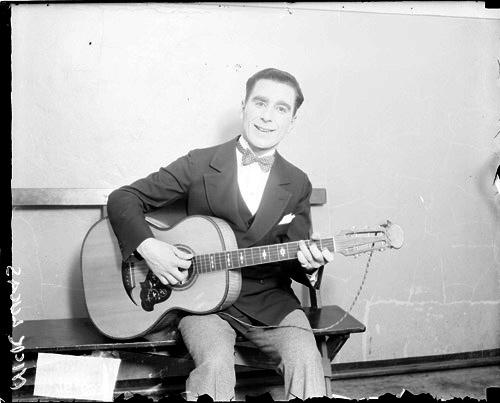
Dominic Nicholas Anthony Lucanese, better known as Nick Lucas, was an American singer and guitarist. He was known as The Father of Jazz Guitar. He was popular during the mid 1920’s to the 1930’s.
Let me clarify the term Jazz. It was originally associated with an amalgam of syncopated popular music. This sort of music was played by New Orleans artists as well as small orchestras. It was the music of the 1920’s long before it became Jazz as we know it today.
Nick Lucas had a couple of popular tunes that became hits. These were Picking The Guitar and Teasing The Frets. His fame increased when he co-starred in a movie called The Gold Diggers of Broadway. In this movie he sang two songs that would become popular, which were Painting the Clouds with Sunshine and Tiptoe through the Tulips.
From Gibson Catalog
Due to his popularity, the Gibson Company wanted their instrument in his hands. It made economic sense to Gibson to get their instruments to well known artists, so a special model was designed for him. And it was quite a guitar.
Nick Lucas tells this story about the instrument. "When I was working at the Edgewater Beach Hotel, I was playing a Galliano guitar that I brought when I was in New York for $35.00. Frank Campbell, who was general sales manager for Gibson, was trying to persuade me to get rid of the Galliano.
This was in 1924. I said, "If you'll build a guitar to my specifications that's not too bulky, I'll throw this guitar away” I wanted a wider neck, deeper sides, and a smaller body that would be more presentable on stage.
I was very happy with the instrument they made, and I still have it. That guitar was made in 1925. You'd be surprised how this guitar carries!”
All Brazillian rosewood.
The original model that Lucas used was finished in black and came with banjo style tuners.
He did not actually throw the Galliano guitar away, but gave it to his brother, Anthony. Lucas kept a backup guitar in the event a string would break during a performance.
His collection and other memorabilia are now housed at a Santa Monica theater where he often played. The collection includes some other Gibson models including a J-160E, several Gibson Lucas guitars, a Martin 000-45, his Galliano and an Orpheum signature archtop.
1928 Nick Lucas
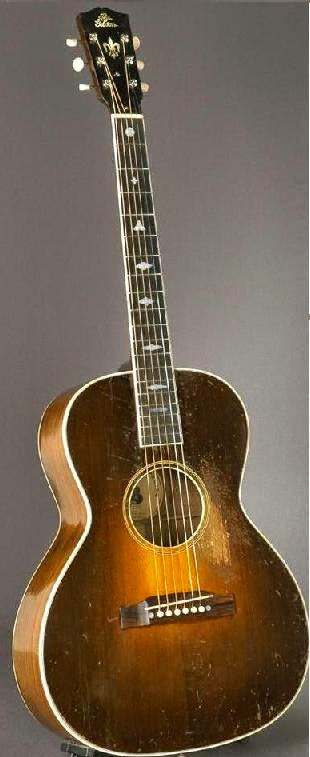
The Nick Lucas model began its run in 1928 but was offered in the catalog as early as 1927. It originally sold for $125.00 USD, which was a princely sum during this time period. It was a small guitar and was only 13 1/4” across the lower bout. The top made of spruce and the back and sides were solid mahogany. This instrument featured a rosewood “belly” bridge with pyramid carvings on either side. The bridge pins were white and included an extra pin below the bridge saddle. The rosette was a 2 ring multi-ply pattern. The guitar was finished in sunburst with a brown stain on the back and sides.
1928 with trapeze
The body was 4 ¼” deep which was fairly deep for this model guitar. This was requested by Nick Lucas as part of the design. He also wanted the neck to be slightly wider than on prior L-series instruments. The scale of the Nick Lucas Model was 24 ¼”. The earliest version had an angle logo spelling out, “The Gibson” that was silk-screen in white letters into the headstock veneer.
Special Label
The rosette around the sound hole was made of alternating white-black-white wood strips. The fretboard inlay included a white five point star on the 3rd fret. The top and bottom of the body were bound and the neck, which attached to the body at the 12th fret, came with triple binding. The fingerboard was made of rosewood with varied patterns for the position markers. “The Gibson” logo was silkscreen onto the headstock. The tuners were made by Grover.
The original models had the round bottom body. There was a special “Nick Lucas” label inside the body.
1928 Nick Lucas
Later in 1928, “The Gibson” logo was inlaid in pearl. The pyramid bridge underwent a slight change and the fretboard inlays were now a more varied pattern with a notched diamond shape on the 3rd fret. The headstock included a Fleur-de-lis inlay below the logo.
1929 Nick Lucas
In 1929 Gibson completely redesigned their guitar line up and increased the body size to 14 ¾” across the lower bout. Most instruments of this year join the body at the 12th fret, but some joined at the 14th fret. The 14 fret models had a glued in pick-guard while the 12 fret versions had and elevated pick-guard. The rosette was now a just a 3-ply ring. The pyramid designs on the bridge were gone in favor of just a rectangular rosewood bridge.
1930 Nick Lucas
The guitars top was still solid spruce and the back and sides were solid mahogany. By 1930 the shape and most of the specs remained the same but for the bridge. This was now an adjustable bridge with a trapeze tailpiece. The neck was raised on these models and joined the body at the 13th fret. By 1932 the back and sides were made of solid rosewood. The bridge and saddle came with the option of a standard rectangular pin bridge or the trapeze tailpiece with the adjustable bridge.
This guitar came with an elevated pick-guard or a glued on pick-guard. The fretboard was now made of ebony and raised off the guitar’s top.
1934 Nick Lucas
This design continued until 1934. Gone were the rosewood back and sides, which were replaced with maple or mahogany. This version had the rectangular pin bridge. The neck joined the body at the 14th fret. The pick-guard was glued into place. This guitar had additional inlay at the 1st fret. It was available in sunburst or black. This design remained until 1941 when Gibson discontinued the guitar.
1964 Bob Dylan with '30's Nick Lucas
The guitar experienced a brief resurgence around 1964 because Bob Dylan was playing a vintage 1930’s model 13 fret Nick Lucas guitar in concert and in album photographs. Dylan’s guitar had a bridge that was replaced with a Guild bridge and the guitars body was refinished to show the natural wood instead of the original sunburst color.
In those days these were considered “used” guitars and could be bought rather inexpensively. Gibson did not take advantage of reproductions in those days.
1935 Gibson L-C
Back in the 1980’s I wandered into a local music store that had a Gibson L-C for sale. This was a beautiful looking guitar and tucked away in a glass display case. As I learned more about vintage instruments I realized this was more of a display piece than a quality player instrument.
1935 L-C
The L-C was produced from 1933 to 1941. This Gibson model featured a 14 ¾” span across the lower bout of its sunburst spruce top. The back and sides were made of maple and triple bound on the back as well as the top. The neck was triple bound as well. The fretboard and the peg head veneer were made out of white pearloid (plastic) with notched diamond inlay and rosewood rectangles or hearts and flowers or a wreath pattern.
1936 L-C
The one I saw had hearts and flowers at position markers. The neck joined the body at the 14th fret. The original retail price for this was $55.00 USD. It was certainly a beautiful guitar. In 1937 it was offered with a Hawaiian set up. By 1938, the peghead had rosewood veneer with a pearl Gibson logo. The last year for this model and its Hawaiian version was 1941.
1942 LG-2
The L-Series guitars sort of resurfaced in 1942 as the LG series (Little Guitar), and were labeled the LG-0, LG-1, LG-2 and LG-3. Only around 100 models of each were produced this year, and then the LG-0 and LG-2 were discontinued.
1943 L-1 and L-3
The LG-1 and LG-3, which continued to be produced in 1945, had a spruce tops. The LG-1 had ladder bracing, while the LG-3 had X bracing.
1958 LG-0
By 1958 the LG-0 was introduced as the new low-end flattop student guitar. It had ladder bracing under its mahogany top. The guitar was finished in brown.
By 1962 to 1963 the L-Series were replaced by the B-25 models. These were discontinued in 1977
In 1987 Gibson was under new ownership. This year the company bought out the Flatiron Mandolin Company and moved its acoustic manufacturing operations to Bozeman Montana. By 1990, under the leadership of luthier Ren Ferguson, Gibson began creating a reproduction of its L-00 series guitar along with many other of its well-known models.
2014 L-00 Pro
As of today, the company continues to offer a couple of L-Series instruments. These include the Gibson L-00 Pro, which has a solid Sitka spruce top, solid mahogany back and sides, and an unbound mahogany neck with Indian rosewood fretboard and white dot markers. The belly bridge is made of rosewood. The headstock veneer has a period-correct Gibson decal logo. It sells for approximately $1400.00 USD new at Guitar Center.
2014 L-1 Blues
The Gibson 1928 L-1 Blues Tribute is based on Robert Johnson’s guitar. It features a faded sunburst finish and a rounded bottom on the body. The belly bridge is rectangular with white end pins. The unbound v-shaped neck, which joins the body at the 12th fret, has a rosewood fretboard topped with white dot inlays and is 1.77” at the nut. The headstock veneer is topped the Gibson logo inlaid in pearl. The tuners are period 3-in-a-line open back models. It is a beautiful guitar and comes with its own form fitting hard-shell case. The L-1 Tribute retails for $3299.00 USD.