When I was 13 years old, I would arrive for my guitar lesson about an hour early at Dodds Music. That way I could check out all the new guitars. I can recall when the store had this beautiful guitar that I had ever seen.
It was a
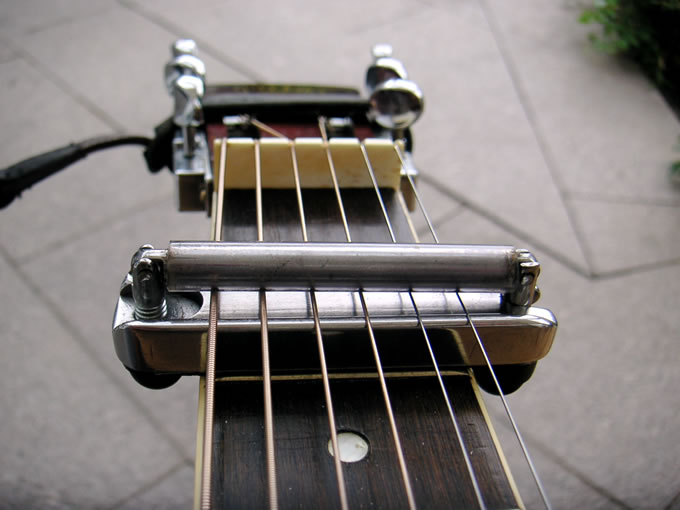
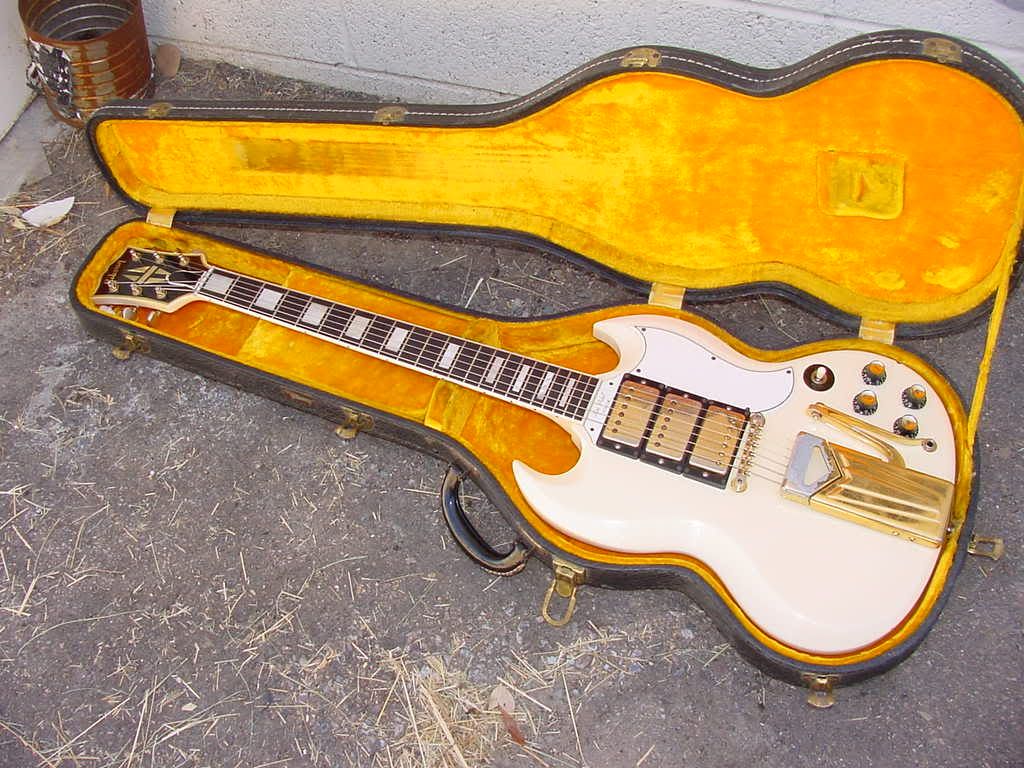
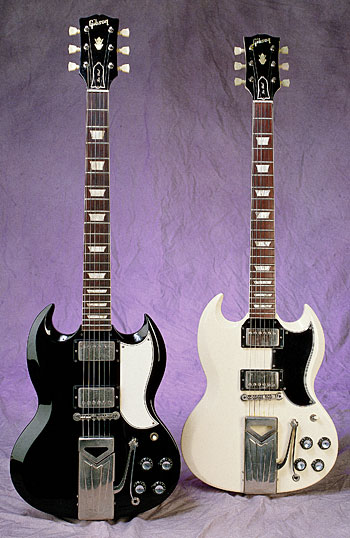
Gibson SG Custom with an ivory finish, three gold-plated pickups and a gold-plated side-to-side vibrato. The neck was ebony with large block fret markers and the headstock had large white pegheads. The emblem at the base of the neck proclaimed it to be a
“Les Paul.” What a beauty.
In my opinion, the SG shape has to be one of the most original guitar designs. It was shaped like no other guitar at the time. Gibson gave it the designation SG which stood for solid guitar.
Believe it or not, the SG was introduced in 1961 as a replacement for the single cutaway Les Paul Standard.
Sales of Les Pauls were on the wane and Gibson wanted a new flashy guitar that would attract players.
I have been unable to determine who actually designed the SG. Gibson attributes the SG design to
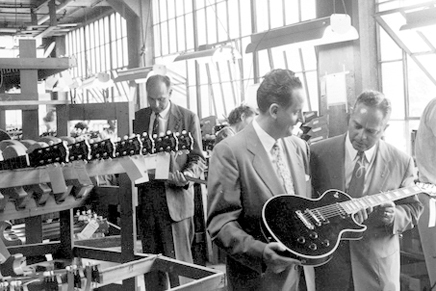
Ted McCarty. He was head of the company at the time and is credited with designing a number of Gibson's other instruments.
There are some folks that believe the SG's body started out as a
Les Paul body slab which a designer cut with an extra cutaway. To me the SG looks like a totally different guitar that is very unique and original. The SG is very different in size and shape from the single cutaway Les Paul.
What we know for certain is that Les Paul was not very fond of the new guitar. At the time of its creation he was under contract with Gibson. Because of that
Les and his wife, Mary Ford, appeared in Gibson advertisements holding the SG.
Paul states the first time he saw the new guitar he was passing a music store window and there was this new instrument with his name on it.
It was not to long after that, Les ended his affiliation with Gibson. Some surmise it was because he was angry about the SG and others contend he was divorcing his wife and did not want her to receive any royalties from guitars being sold using his name. Whatever the case
Les Paul asked Gibson to remove his name from the guitar.
In 1963 Gibson renamed the guitar
the SG Standard. The new SG's outsold the Les Paul single cutaway. In the first three years it was introduced it sold on average 6,000 units each year, while the LP only sold 1700 units during 1958 through 1960, its final three years.
The body of the SG was thinner than its predecessor and
the neck had a very slender profile with no heel. The neck joins the SG’s body at the 22nd fret. This makes playing an ease. However some luthiers claim it is a bit of a problem when the guitar falls down, it generally breaks at the neck or head joint.
The SG Standard came with
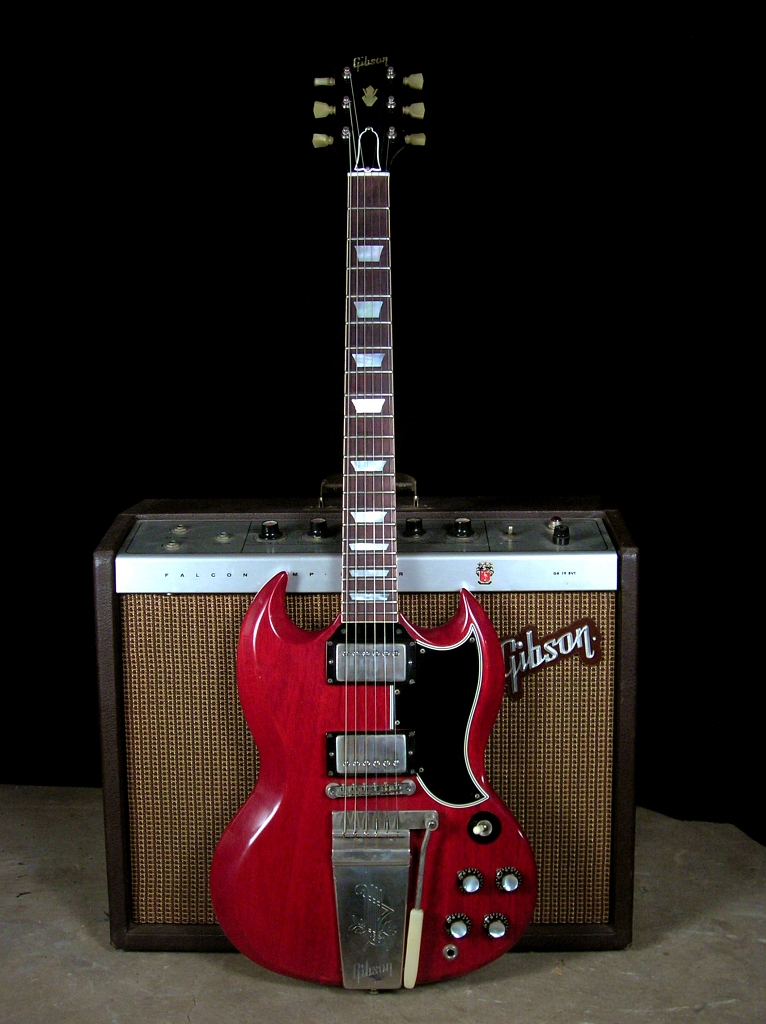
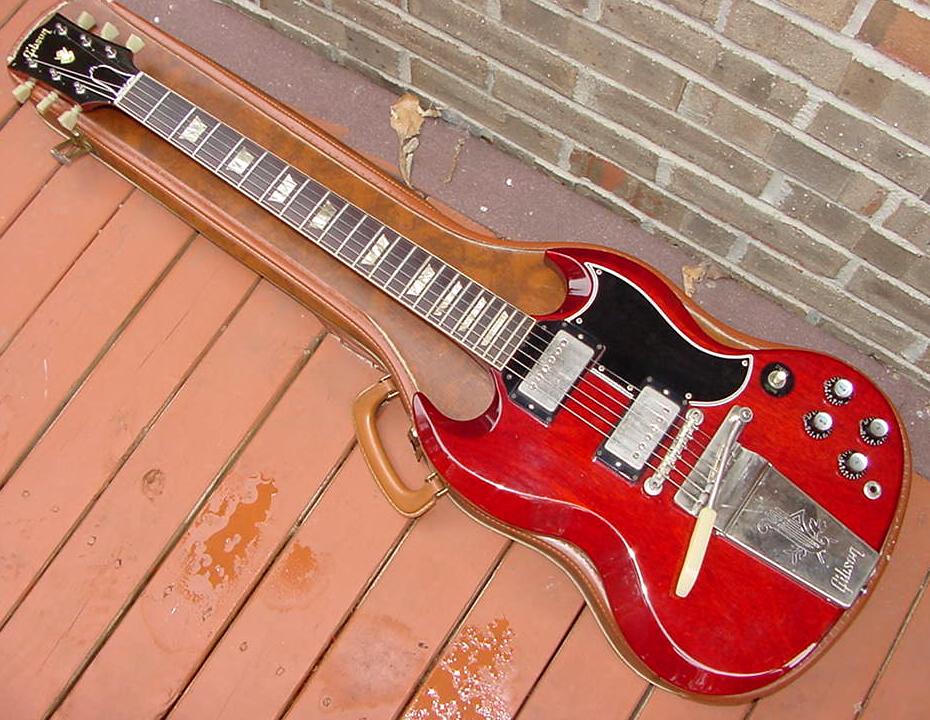
two nickel plated Gibson PAF Humbuckers, volume and tone controls for each pickup and a three way toggle switch. The first models included a nickel plated
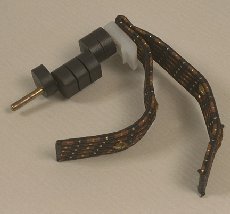
Gibson side-to-side Vibrola. It was later offered with a Bigsby vibrato tailpiece or a
Gibson Maestro Vibrato, with the long metal medallion that stretched from the end of the vibrato to the tailpiece.
Gibson also offered
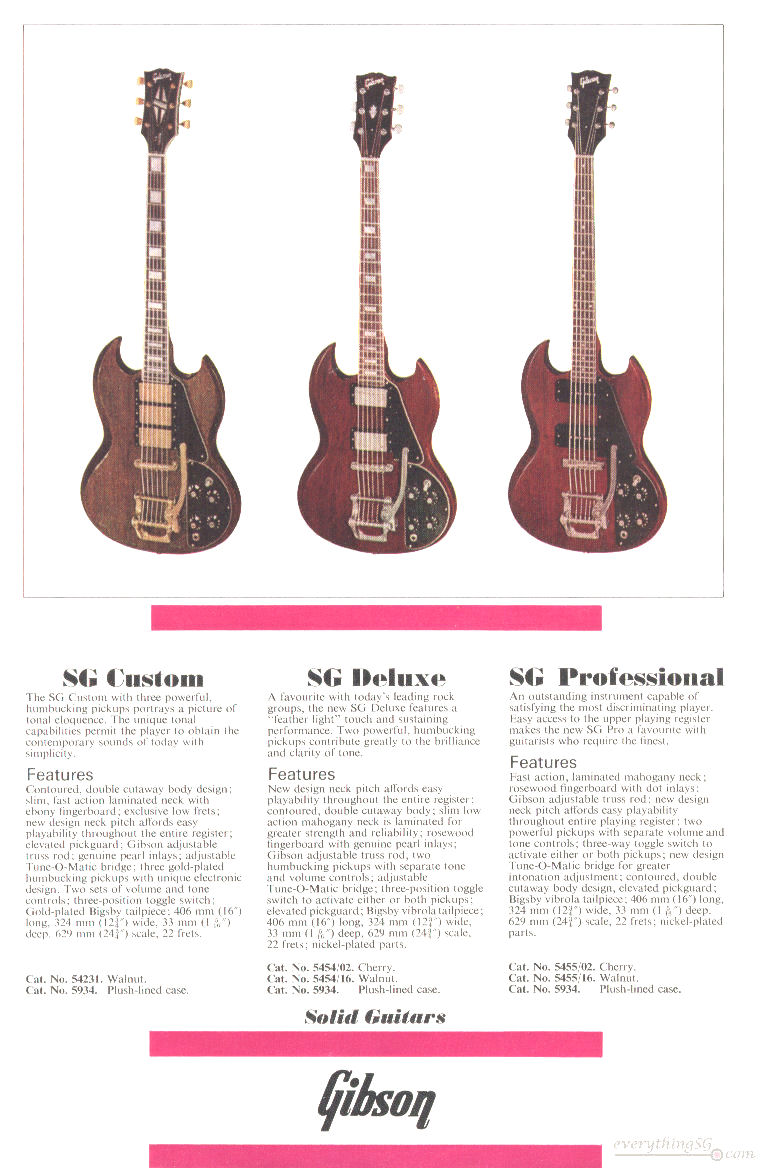
the beautiful SG Custom. This was the guitar that caught my eye at the music store. This beauty had a clear white finish and three gold plated Gibson PAF Humbuckers. The Custom came entirely with
gold plated hardware. Some early SG Customs came with a
short Gibson Vibrola instead of the one with the full cover. There are also some SG Standards and Customs that feature with
Gibson’s Maestro Vibrola that have a white plastic handle on the tip of the arm. This option was introduced as a option in 1963.
The Kluson knobs had white molded plastic buttons.The SG Custom's three pickups, were designed to work in the following manner. The two volume control and two tone controls were for the bridge and neck pickups. The middle pickup had no controls and was designed to work with the bridge pickup. On the original models the three way toggle switch controlled the neck pickup and the middle and bridge pickups out-of-phase and the middle and bridge pickups in phase.
When the change was made to
Bigsby vibratos on some SG Customs a few came with pearl inlaid ebony at the base of the vibrato. This was offered in 1962.
In 1961
the Gibson SG Standard (Les Paul) sold for $310, which was a substantial price in that era.
The original
SG bodies were all made of solid mahogany. The SG Standard came with twin humbucking pickups, a mahogany neck with an ebony fretboard that was inlaid with pearloid trapezoidal makers.
Some came with the Gibson Vibrola side-to-side vibrato unit. Later this was replaced by a Bigsby B5 unit or the Maestro Vibrato. All hardware was nickel plated except the tuners, which had molded plastic tips.
All of the SG Standards and Customs came with Gibson’s Tune-O-Matic bridge, however
the SG Junior and SG Special came with Gibson's wrap-around bridge.
No matter the model
the SG neck is always a set in neck. As with many Gibson guitars, the SG neck is a 24 ¾ inch scale. The SG Standard and Custom have bound necks and the logo Gibson inlaid in the headstock, while the SG Junior and Special came with white dot position markers and a silk screened Gibson logo on the head.
Just like the Les Paul, Gibson offered some less expensive models. They were
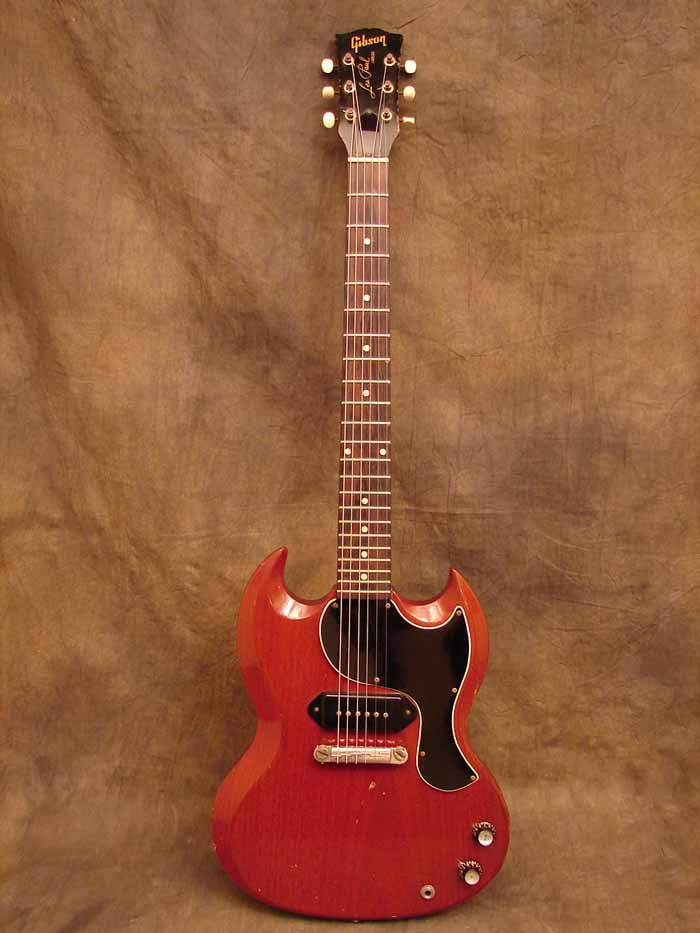
the SG Junior and
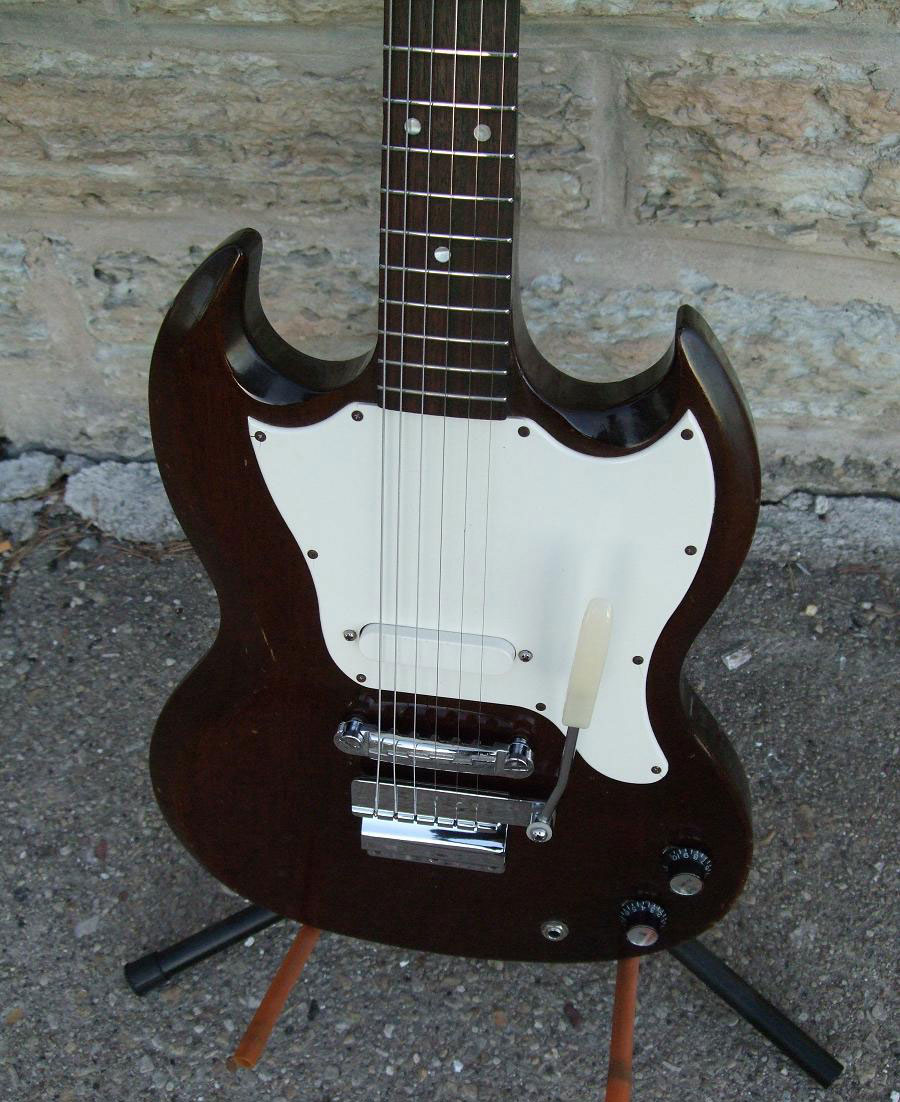
the SG Special. The SG Junior came with one P-90 single coil pickup in the bridge position, while the SG Special came with twin P-90 pickups. The pickups came with a black plastic cover.
In 1962 Gibson realized the problem with the neck and thickened the profile.
By 1964 Gibson decided to use six screw to anchor the pickguard instead of four.
By 1965 Gibson gave its budget
Melody Maker guitar the SG shape and offered it with a Pelham Blue or Fire Engine Red finish. Gibson also offered SG’s in the Pelham Blue finish, however they never caught on.
In 1966 Gibson redesigned the SG’s neckset and heel and enlarged the pickguard. Models sold from 1961 through early 1966 came with a small pickguard. The new pickguard was nicknamed the Batwing.
There are a few unusual Gibson SG guitars that were introduced in 1971 and both were discontinued the following year. The first is the Gibson
SG Pro. This was a cherry red model with twin P-90 pickups, a Tune-O-Matic bridge and a Bigsby vibrato tailpiece.
The neck was unbound with a rosewood fretboard. The markers were white dots and the logo was silk screened on the headstock. The unusual feature was the triangular shaped black pickguard and the semi-circular black plastic panel that held the controls and input.
The guitars controls consisted of two volume and two tone potentiometers with black witch hat knobs and a three way toggle switch, all housed on the panel.
The other Gibson offerings were the SG 100,
SG 200 and SG 250. These were really odd instruments that were offered around late 1970 or 1971. All had the SG style body, but this time it was made out of maple, however there are examples made of mahogany.
The necks were set maple with 22 frets on a rosewood fretboard and dot inlays. The headstock was black with the Gibson logo silk screened in gold ink.
The SG 100 came in cherry red or walnut and had one slanted single coil pickup with a black cover similar to what one would find on a Melody Maker. This time it was in the neck position. The pickup cover was surrounded by a nickel plated base. It was offered in cherry or walnut.
The control plate was made of a rectangular piece of nickel plated metal and slanted at the lower bout.
This housed the volume, tone controls and an input. This guitar also came with a nickel plated hand rest adorned with the Gibson logo that fit over the guitars redesign Tune-O-Matic bridge. This bridge was different from Gibson’s normal one. It was more like a Fender hardtail bridge.
The SG 200 was the same as the 100, but came with two similar pickups. The control plate was a little longer to accommodate two on/off slider switches, one per pickup. It came in cherry red and walnut.
The SG 200 was also available with a Maestro Vibrola. Some of the SG 200 came with a trapezoidal pickguard.
The only difference between the SG 200 and SG 250 was the finish. The SG 250 came in a cherry sunburst finish. This series of guitars all had nickel plated hardware. The tuners were by Kluson.
Perhaps the reason these guitars were not popular had to do with the design. The neck, fretboard, and strings were parallel to the top of the guitars body. This resulted in the guitar having a high action for all of the SG 100 line up. Plus the SG 100 series single coil pickups all sounded tinny.
As I stated, this line only lasted a year and was replaced in 1972 by the SG I,
SG II and SG III.
The SG I appeared to look like the SG Junior. However it came with one mini humbucking pickup in the bridge position that had a black plastic cover. It had a trapezoidal shaped pickguard and a semi-circular black plastic control panel on the lower bout, similar to the SG Pro. This housed the volume, tone controls and the guitars input. Most players at some point, discard the pickguard.
The SG II was similar to the SG I except it came with twin mini-humbuckers. The control panel was similar as well but for the two slider switches to control the pickups off and on function.
Once again the
SG III was the same guitar as the SG II, except once again it had a cherry sunburst finish. All guitars in this series were made of mahogany. Gibson used Kluson tuners and a wrap-around bridge.
You will find a lot of examples of this guitar with the bridge changed out to one that is adjustable. The SG I and II came with cherry or walnut finishes.
In 2007 Gibson issued a new SG III guitar, but this one was quite different from the original. This guitar had a white pickguard that covered most of the bodies’ upper section. Housed in the pickguard were three single coil pickups. The single volume and tone control was on the guitars lower bout. Additionally a 6 was rotary knob was placed near the other controls. This control allowed the player to select all pickup combinations.
The hardware was nickel plated. Tuners were by Kluson. The tail piece was a stop unit with a Tune-O-Matic bridge.
 |
| Steve Moore's SG |
There are innumerable SG models that Gibson came out with over the years. One model that I have not been able to track down had an elaborate design of grapes, leaves and grape vines carved in the upper and lower bout. A good friend mine owned one of these.
It had two chromed humbucking pickups and nickel plated hardware including the Tune-O-Matic bridge and stop tailpiece.
I know
Guild made a guitar with carving that looked like an SG.
Guitarist Steve Moore also owned and played one, but his was heavily customized with an extra pickup, additional controls and a gold plated Gibson Vibrola
Perhaps the most unusual
SG was Gibson’s Robot Guitar. This SG comes with an auto tuning system developed by the German company Trionical.
The Tune-O-Matic bridge houses individual piezo units that are connected to a micro processor. The computer then analyses the signal and commands
each of the guitar's Powerhead Locking Tuners which automatically pull the strings into tune. These tuners operate by means of small servo motors.
The Robot guitar contains a small lithium rechargeable battery to power the motors. Gibson offers this technology to several of its models.
One guitar that is mistaken for an SG is
the redesigned Melody Maker. This guitar was first produced in 1969 as a replacement for the double cutaway Melody Maker. The newer version was given the SG shaped body with one, two or three pickups.
There were differences between the Melody Maker and the SG starting with
the Melody Makers narrow headstock, single coil pickups with white plastic covers, cheaper tuning pegs with plastic white buttons and a large white pickguard.

The one pickup model had a single coil pickup in the bridge position. The next Melody Maker added a neck pickup and two on/off slider switches, plus a volume and tone knob for each pickup. While the rare three pickup model came with, you guessed it, three single coil pickups.
However there was only one three position slider switch. The instrument came with two volume and two tone controls.
All of the three pickup models I have seen came with a Gibson Maestro short arm vibrato with the plastic tip on top of the arm.
The biggest complaint about this era’s Melody Maker with the
cast saddle bridge and the cheap tuners. This along with the vibrato made tuning difficult. I am told the pickups are great and sound warmer than Fender pickups.
The original models came in Fire Engine Red or
Pelham Blue. A burgundy version was added a year later as was
Inverness Green.Some old Pelham Blue models are mistaken for green. This also happens with old Pelham Blue Fenders as the yellowing effect of the clear coat lacquer seems to fade to a greenish hue through the years.
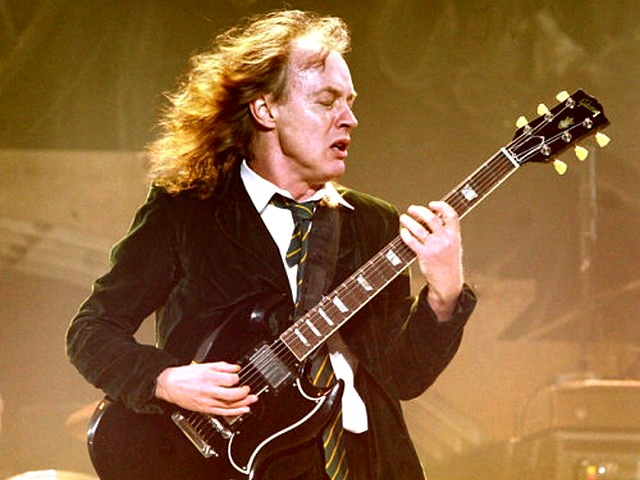
Famous celebrities have, from time to time, made the Gibson SG their signature guitar. Angus Young would never be caught performing with anything else. George Harrison, Eric Clapton, Tommy Iommi and Todd Rundgren have all been associated with the Gibson SG Standard.
The one standout SG was owned by Eric Clapton during the Cream years. It started out as a cherry SG standard with a Gibson side-to-side vibrola. The year 1967 were the days when Psychedelic art was in fashion. Clapton had his SG repainted by Dutch artists Marijke Koger and Simon Postuma who were part of a pop artists group called The Fool Collective.
Actually it was the Cream’s manager, Robert Stigwood, who contacted Koger to do artwork for the band.
Clapton’s SG was repainted with Psychedelic designs, as was Ginger Baker’s drum set. A Fender Bass VI was painted in Psychedelic patterns for Jack Bruce, but he preferred his four string bass.
Clapton referred to this guitar as
The Fool, after the artists.
The history of The Fool becomes a little murky after Clapton retired the guitar. He either gave it to George Harrison or Jackie Lomax. There are some who believe Jackie Lomax acquired it from Harrison. Lomax then sold the guitar to Todd Rundgren for $500. Rundgren renamed the guitar, Sunny. In 2000 Rundgren put Sunny up for auction and it sold for $150,000. This guitar has been copied numerous times.
I had to post this video of Gospel singer Sister Rosetta Tharpe. She was one of the first to make
the Gibson SG Custom her trademark guitar.