Selasa, 29 Januari 2013

Joni Mitchell's Guitars and Tunings


Joni Mitchell is coming to my home town next month. Out of the three great lady folk singers of the early 1960’s, Joan,Joni and Judy, Joni Mitchell was by far the most interesting guitarist. Plus, she used many very interesting guitars and many more interesting tunings.

The first professional instrument she owned was acquired back in 1966 when she received a 1956 Martin D-28 from a Marine captain. The captain was in Vietnam when his tent was hit with shrapnel, injuring him. 


The captain had two guitars inside his tent at the time. Joni claimed this Martin to be her best guitar ever. She wondered if the explosion did something to the modules in the wood, since the guitars sound was incredible. 

She used this guitar on all of her early albums. But by the time she recorded Court and Spark; the guitar had been damaged by an airline carrier and soon after was stolen from a luggage carousel.

It was in the latter 1970’s when she turned to electric guitars. She preferred George Benson model Ibanez guitars which she usually played through a Roland Jazz Chorus amplifier. To keep up with her unique tunings, Joni traveled with five similar Ibanez guitars

Each guitar was strung with differing sized strings which were matched to the tuning she used. She states that the guitar has to sound crystal clear when playing harmonics. Therefore the more slack the tuning was, the heavier the strings needed to be.

During that same decade Steve Klein built her a wonderful handmade guitar in Klein’s own interesting and decorative style. This instrument was visually and technically a masterpiece. The sound hole’s rosette ring could be removed to provide a larger bass voice that can be tuned by affecting the air resonance of the body. The inlays are I-Ching hexagram number 56. The Wanderer graces the face and upper bout of the instrument and Don Juan’s crow flies on the head stock.

Theacoustics she now owns and uses include two Martin’s; a D-45 and a D-28 and a Collings D2H and a Collings ¾ size guitar. All guitars are equipped with Highlander pickups, although she makes use of an external microphone on stage.

In 1995 Fred Walecki, the owner of Westwood Music in Los Angeles, built a unique Stratocaster style guitar for her.  The body was made of lightweight German spruce and the neck was made of maple. This instrument contained a hex-pickup that could be used in conjunction with a Roland VG-8 synthesizer. 

This instrument opened new options for Mitchell. Though the guitars strings maintained original tuning, the synth could alter each strings timbre and pitch. Instead of carrying around five instruments, she could now pack one guitar for her concerts, programming the Roland guitar synthesizer to match her variety of tunings. 

Not only was it useful for her variety of tunings, but also for the unique sounds she could coax from the Roland synth.

More recently I have seen videos of Joni wielding a 2008 Parker Fly Mojo Flame guitar. She uses this guitar as a synth controller in combination with a Roland VG-8 guitar synthesizer.  

This guitar alos contains the built in Hex pickupand a piezo pickup that allows her Parker guitar unique sounds to match her music.

For the unfamiliar, it was during the early part of 1960’s that folk music briefly became the rage. This music grew out of the clubs around Washington SquarePark and New York City’s Greenwich Village.  

Many famous players started due to their love of acoustic blues music. The clubs attracted a hotbed of musical talent. Name a well known folk artist and you can be sure he or she got their start by playing at one of these club.  

Joni states she purchased Pete Seeger’s How to Play Folk-Style Guitar. She was so proficient that she skipped ahead of the book’s lessons and learned to fingerpick the way Elizabeth Cotton picked on her famous song “Freight Train.” And though she may not have mastered that alternating 1 – 5 bass line, Mitchell did come up with her own style.

I recently learned part of Joni's reason to use alternate tunings was due to having polio as a child, which affected her left hand. The altered tunings allowed her to play chord shapes that she could not get her weakened hand to play.

Like many guitar greats, the way she strokes and picks the strings with her right hand is the heart of her guitar sound.  Her style went beyond finger picking as she concentrated more and more on song writing.

Early on she caught on the some of the open tunings of blues players. From there she built up a bevy of tunings for her songs.


For instance she says the simplest tuning in her opinion is D modal (DADGBD). She also utilizes other simple tuning in open G (DGDGBD) and open D (DADF#AD).

For her two most well known songs, Both Sides, Now and Big Yellow Taxi she uses a capo on the second fret and tunes to open E (EBEG#BE). She makes use of the capo along with the diverse tunings. For Marcie she tunes to CBDFCE.

Mitchell claims she experiments by attempting to play her songs with different tunings to get a larger sound. She visualizes sounds as colours and shapes. To date, Mitchell said that she has used 51 tunings. Some tunings recur at several pitches. Generally speaking, her tunings started at a base of open E and dropped to D and then to C, and these days some even plummet to B or A in the bass. This evolution reflects the steady lowering of her voice since the ’60s, which occurs in all of us as we get older.


Mitchell has come up with a way to categorize her tunings that reminds me of Nashville Notation.  Since the guitar is tuned in fourths which occur on the fifth fret, standard tuning is 5 5 5 4 5 with E as the bottom string. 


Her tunings include 7 5 or 7 7 for the bottom strings. As an example, Free Man in Parisutilizes D A D G B D (the 7 5 tuning).

For those who are interested, the only published documentation of her 30-year guitar odyssey is four single-album songbooks transcribed by Joel Bernstein, her longtime guitar tech and musical/photographic archivist, which show the real tunings and chord shapes.

Joni Mitchell frequently turns to the dulcimer in her on stage performance. During a back packing trip Mitchell did not take a guitar, but did bring the dulcimer and a flute, learning to play both instruments.


I may add that Mitchell is also an accomplished pianist. And I cannot leave out the fact that in the 1970’s Joni was very dissatisfied with the standard bass style of the era. She came across a bass player from Floridanamed Jaco Pastorius, who gave a very interesting flavor to her songs. 

And of course Pastorius became on of the most recognized and sought after bass players of his era.

Here it is 2013 and Joni Mitchell is still singing and playing her songs to the delight of her fans and admirers.

2015 Update: Joni has recently suffered an aneurysm which has affected her speech. Let's all wish her the best and a speedy recovery.


 Check out her fingerings in this 1970 video.


Rabu, 16 Januari 2013

Acoustic Travel Guitars Part 2

(I apologize that this review took so long to publish. I had some issues come up in December that delayed  finishing the article. Thank you for understanding.)

Upon doing some further research I discovered there are many companies that offer acoustic travel guitars as part of their line up.

Part One of Acoustic Travel Guitars was based on instruments which I am familiar. Part Two is Acoustic Travel Guitars that I have run across on the web or in reading material.


Blackbird Nylon strung
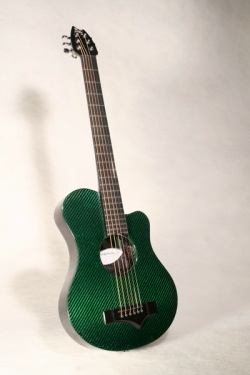
The first highly unusual and highly expensive acoustic travel guitar is made by a company named Blackbird. The Blackbird Rider Nylon guitar is made of carbon fiber, in the manner of Rainsong Guitars. This is considered a green guitar, although the finish is actually black. No trees were harvested by its manufacturer. So it is CITES approved.

The Rider is indestructible according to the literature. It weighs in at right around 3 pounds. The body on this guitar is somewhat trapezoidal.

There is no sound hole. Instead it has been replaced by a “sound scoop” on the upper bout facing the player. The Rider also comes in a steel string version.

Perhaps the downside is the price. The nylon string version sells for $1900 USD and the steel string Rider sells for $1800.

The Composite Acoustics Cargo travel guitar is another instrument made of carbon fiber, which the manufacturer refers to as composite. As with all carbon guitars, including this one, you get durability and strength in a lightweight package. This guitar holds up well in extreme temperatures and if the airline handles this guitar in a rough manner, it is not going to break.

The instrument’s unique design might be mistaken for an Ovation guitar. It has a fairly deep cutaway which slants downward at the end of the guitars neck, making those high notes very accessible. The sound hole is traditional on this short scale guitar. The fingerboard is also made of composite material, as are the top, back, sides, bridge, saddle and nut.

This instrument comes with an active L.R, Baggs Element, under-saddle transducer with a volume control.

The scale is 22-3/4 inches. Like the Blackbird Rider, this guitar is much too expensive. Its suggested retail price is $1800, but you could probably get one for around $1478 if you are so inclined.

Composite Acoustics: (337) 233-4119; compositeacoustics.com.

The Hawaiian Backpacker Acoustic Travel Guitars, looks much like a Martin Backpacker. The Asian manufacturer refers to it as a Hawaiin/Dulcimer Acoustic Camping/ Backpack guitar.

The guitar is 35 inches from the top of the neck toward the distal end of the guitar. It is only a mere 7-3/4 inches at its widest point.

This is a steel string instrument. The bridge is a traditional style (probably movable) wooden bridge. A mandolin style tailpiece anchors the strings. The Hawaiian Backpacker Acoustic comes with its own gig bag and is a steal for under $40 USD. It comes in natural, black and burnt-red finishes.

The Enorez Travel Guitar is made by a Chinese manufacture and imported by an east coast USA company called Zero One. If you spell zero one backwards, it is loosely Enorez.

Their travel guitar is quite unique. The thin and small body is reminiscent of the shape of an old mandolin. The strings are anchored on the head of the neck and are strung to the tuners at the bottom of the instrument. It looks backwards. This guitar comes with a hardshell tweed case and will set you back $170 to $180 USD.

Yamaha comes in with a sort of acoustic travel instrument they call The Guitalele  GL-1. This is actually a small nylon strung acoustic guitar.

Back in the 1920’s stringed instrument manufacturers were coming out with variations on the banjo such as the banjo-uke, the banjo-mandolin and banjo-guitar. The Guitalele seems to be the current decades version.

Yamaha suggests you tune this instrument to ADGCEA, to compensate for the short scale. This allows you to play guitar chords on the instrument and stay in tune.

The price is around $100 USD. Yamaha considers it to be a fusion of the guitar and the ukulele.


The price is not much more than what mid-priced ukes are currently selling for. The benefit of the Guitalele for a guitarist is not having to learn ukulele chords.  I could be a great at instrument for a guitarist looking for a new way to play, or a ukulele player who wants to produce a fuller sound. The scale is 17", so tuning up a fourth is a must. This is another travel guitar that is sized small enough to fit in an airline overhead compartment.

Tanglewood TB Baby
The TB Baby and Baby Deluxe were offered by the Tanglewood Guitar Company of the U.K as part of their Evolution series. The TB Baby has a similar appearance to the Baby Taylor. The guitar was an all laminate model. The TB Baby Deluxe came with a solid top and sold for around $129 USD. They also made a TB Big Baby. You might check eBay for used models.

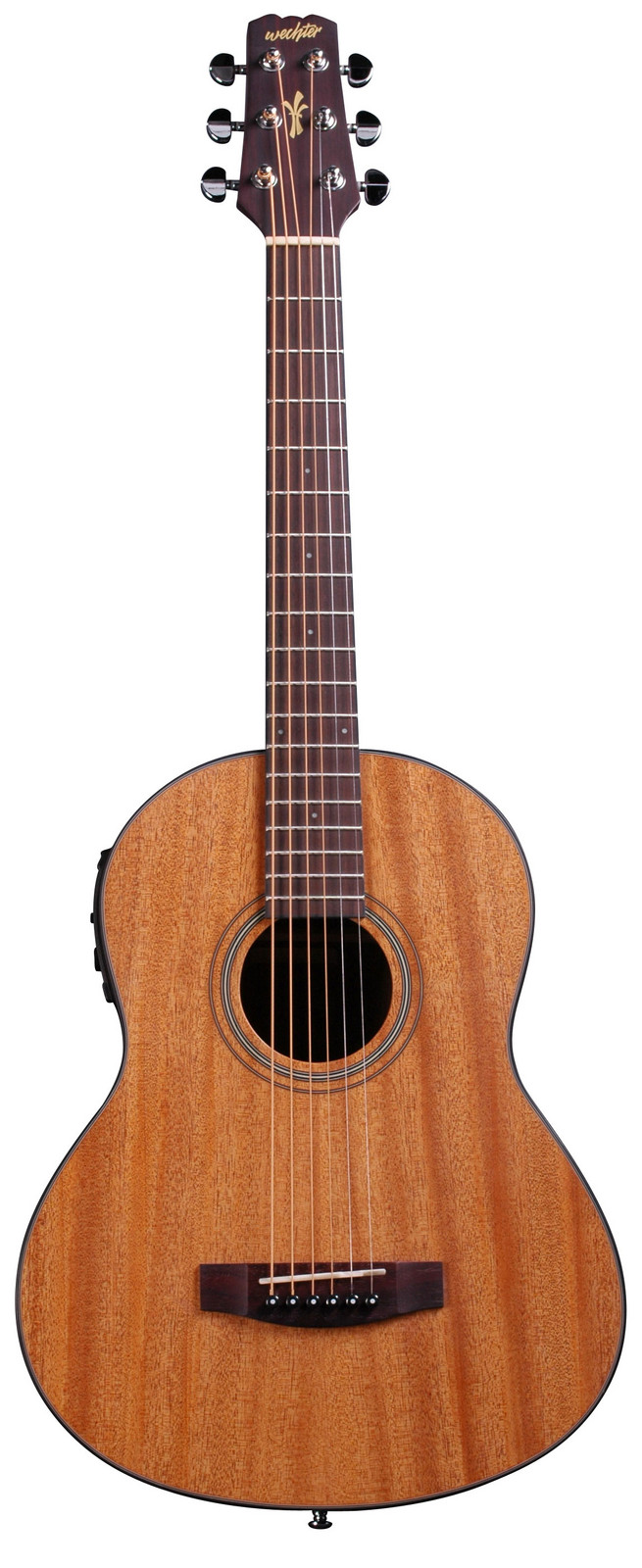
Wechter guitar offers a small travel guitar, model 1720 Elite. This comes with a solid mahogany top, sides and back. The neck is contructed of nato wood. The fingerboard is made of rosewood. All Wechter guitars use the Plek Pro Setup system which gives each instrument a personalized factory set up for accurate intonation and is guarenteed to prevent fret buzz. This is done through a computed aided machine with the ability to level frets within .001 mm of accuracy. This enables the 1720 Elite model to maintain a low action for enhanced playability.


The furniture grade mahogany gives this guitar added strength in the event it gets knocked around on a vacation or camping trip. The guitar has a satin finish and a 23.3" scale.


Ovation AA13
Ovation also offers some travel guitars under it's Applause line. These are the Mini-Applause AN13 nylon string guitar and the AA13 steel string acoustic guitar. Both come with spruce tops and Ovation's parabolic back and suggested selling price is $249. The AE13 is an acoustic electric model of the AA13 and sells for $50 more. Gig bags are extra for these instruments

I've mentioned Voyage Air guitars in the past. This company manufacturers full sized guitars with an unique hinged neck. This allows the player to fold the guitar in half an place in a backpacker style case that is included with the instrument. This design meets requirements for airline carry-on luggage.

To pack the guitar away, one simply unscrews a nut at the neck heel.


Surprisingly the hinged neck design is reported not to effect tonality.  Most models sell from $600 to $1000 USD.

This instrument features an East Indian rosewood fretboard and chrome plated tuning heads that top off the neck. The African mahogany bodies with solid spruce tops are manufactured offshore in Korea. The necks are manufactured in the USA and the instrument is assembled in the USA.

Some additional features of the Voyage Air VAOM-04 Songwriter include and hand inlaid 2-ring rosette and 6 ply binding. The saddle is compensated and Voyage Air comes with a proprietary nut design the manufacture refers to as the Captured Nut. The scale is 25.5".

The Amigo Travel guitar can be found on any number of musical instrument web sites including Amazon.com. 

This small guitar has an elongated mandolin shape. The top is solid spruce. The back and sides are mahogany. The Amigo AMT10 comes with a padded nylon carry bag. It is priced from $90 to $120 USD.

The Breedlove Guitar Company offers the C250/CM travel guitar. It is manufactured in Korea. The top is solid western red ceadar. The back and sides are laminated mahogany. It has a short scale of 19.1" and has a street price of aproximately $450 USD.

Breedlove suggests you tune this instrument up 5 frets to A on the first and sixth string to compensate for the short scale. 

The C250 comes with an undersaddle piezo pickup with a built in preamp powered by a nine volt battery. Included is a chromatic tuner that is built in the guitar as well as a tone control.

Emerald X5
The Emerald X5 Life Woody is/was made in Donegal, Ireland. This guitar is the creation of Alistair Hay or Emerald Guitars.It features a one piece carbon composite body and neck. The instrument is enhanced by a redwood burl veneer over the composite fiber. The fiber construction allows the neck heel to have an extreme tapered design allowing easy access to the higher frets. The instrument scale is 25.5" or full scale.

It comes with a B-Band pickup system with a built in tuner and is/was priced at 995 EURO's. It is a beautiful instrument.

Great Divide
For those of you that are short of funds, which would include many of us these days, you may want to look into The Great Divide Campfire SST-N Travel Guitar. $99 USD buys you a small guitar with a solid spruce top, a dove tailed, glued-in mahogany neck topped with a 19 fret rosewood finger board, a bone nut and saddle. The back and sides are laminated sapele wood. The scale is small at only 22.7" and it comes with a gig bag.

Sierra Compass


The Sierra Compass Series ST10 Travel Acoustic Guitar is an excellent travel instrument. It features a solid spruce top and laminated mahogany back and sides. Die-cast chrome tuners and a satin finish.

This instrument includes a high quality padded gig bag. Suggested price is $300 USD.


Alvarez RT16
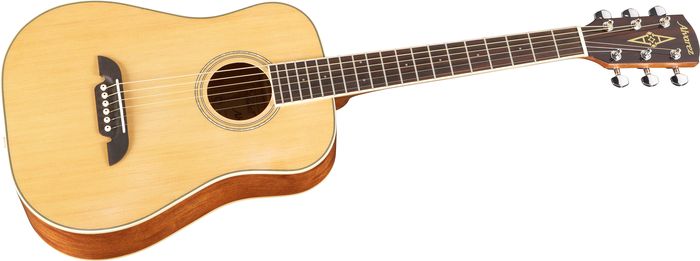
The Alvarez RT16 Regent Series 7/8 Travel Size Acoustic Guitar is a perfectly formed travel sized dreadnought. Compact, yet plays just like a full size acoustic.

The RT16 comes with an Alvarez padded gig bag and has a spruce top and mahogany back and sides. As a 7/8th sized guitar, the neck profile is easier to play. The guitar is constructed using a dovetail neck joint. The bridge is the patented Alvarez bi-level model, designed to enhance vibration. The scale is short at 22.5". The neck radius is 10". The neck is mahogany topped with a rosewood fretboard.

Newporter Mini
Fender guitars offers the Newporter Traveler Mini Acoustic model. This is named after Fender's well known 1965 Newporter guitar.

The new model is a mini-dreadnought with a short scale at only 22.6 inches.

The guitars top is made of spruce with mahogany back and sides. Fender has used a satin finish for the Newporter. The neck is made of mahogany topped with a 20 fret rosewood board. The bridge is also made of rosewood. Like the '65 model, the mini Newporter comes with a Stratocaster style headstock.

Unfortunately one of the best travel acoustic guitars is no longer in production. You might find one on eBay or another auction site. The Tacoma Papoose, by the Tacoma Guitar Company, was made in Washington state.

This wonderful instrument came with a solid cedar top, solid mahogany back, sides and neck. The fretboard was rosewood, as was the bridge.

Since the scale is 19.1", it was suggested by the manufacturer to tune it to A. It was sold with its own gigbag. Uniquely, the "paisley" soundhole was on the upper top bout.

The bracing on these guitars was proprietary and know as the Voiced Bracing Support System.

Tacoma Guitars were designed by Terry Atkins and George Gruhn, the well known collector/appraiser.

Back when these were being marketed, the list price on the P1 model was around $800. Though most Papoose guitar manufactured were six string models, Tacoma also offered a 12 string model.


Breedlove Passport. This is an excellent arrangement - Chet meets Queen.


Minggu, 25 November 2012

Acoustic Travel Guitars - Part 1

When I was a kid, every August I went to band camp for a couple of weeks. I wanted to take a guitar with me to pass the time away, but did not want to take anything valuable or fragile.

So off I went to Wurlitzer Music at 7th and Race in Cincinnati and asked if they had any inexpensive guitars. The salesman showed me some low priced, but nice acoustic guitars.


I explained that I was looking for a guitar to take to summer camp, to which he replied, “Oh, you want a beater. Well why didn’t you say so.”

For 20 bucks I walked out with an instrument very similar to an old Stella parlor guitar. The top was birch, the back and sides made of “who knows what”, cheap open tuners, a piece of wood for a saddle and a stamped metal tailpiece.


It had a steel reinforced neck. No truss rod, but was a steel rod in the neck. A sticker on the back proclaimed Steel Reinforced Neck. This was common on Harmony and Kay guitars and others built by Chicago Music Instrument Company. I still have that guitar and I am amazed at the price similar instruments command on eBay.


This brings me to acoustic travel guitars made for the modern market. I guess you could call them “beaters”, however some are very nice instruments. A few months ago, I reviewed electric travel guitars and much like those instruments, many acoustic models are designed to fit into an airline overhead bin.


\With the acoustic travel guitars you can you sit around the campfire and strum Kumbayah or you can practice in your hotel room, I have seen folks perform with them and some of them even plug into an amplifier.


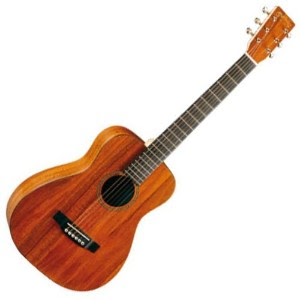
One of my favourites is Martin’s little LXM model. Although it is made of high-pressure-laminate the tone and feel are not at all bad. Don’t expect the LXM to sound or play like an HD-28, but the LXM is not going to set you back four-grand. In fact you can purchase it for less than a tenth of that price.

The LXM and others in the series are constructed to be travel guitars or small guitars for youngsters to learn how to play guitar. The action is excellent (much better than the old Harmony Patrician with a bowed neck that I learned on).

Stratabond neck
The scale length is 23” and a 16” radius. The neck is made of some material called Rust Stratabond. Many of the newer mid-priced Martin guitars come with a Stratabond neck. Stratabond is a process offered by many wood working companies. Panels of wood or wood products, many times of differing colours and materials, are sealed and glued together under high pressure. These can be used as wall panelling and laminated flooring.

One of the more prominent uses of Stratabond is in the manufacturing of rifle stocks. Chris Martin has endeavoured to come up with new materials that will not diminish the supply of natural woods. He and his team chose Stratabond as a neck material for the X series of guitars. I believe that Rust is the colour of some of the laminated wood used. The effect is different and does not alter the guitars playability. In fact the Stratabond neck is likely stronger than a guitar neck made of a single block of hardwood.

Martin LXM Koa
This little guitar comes with modified X bracing. The fretboard has 20 frets in all, 14 are clear of the body. The width at the nut is 1-11/16th” and at the 12th fret it tapers out to 2-1/16th”. The bridge material is made of Richlite, which is a product made by a manufacturer of the same name.


This product consists of eco-friendly paper-based fiber composites used for a variety of building and industrial needs. The saddle is made of white Tusq, an industry standard now that rivals bone, and the nut is made of Corian (yet another building material.) There is no head-cap on the headstock, which is fitted with chrome tuning machines with small buttons. This instrument comes with a gig bag.

For those of you that insist on solid wood being used on your guitar, Martin manufacturers the Backpacker. There can be no doubt that solid wood is used in construction, because this guitar smells like it just came out of a wood mill. The top is solid spruce. The back and sides are made of “solid tonewood” and the neck is made of “solid hardwood” according to Martin literature.

The guitar has a unique tapered shape. This instrument was inspired by Chris Martin’s chance meeting with a fellow named Bob McNally, who designed the Strumstick. The Strumstick is a 3 stringed instrument played like a guitar, but the string and fretting is similar to a fretted dulcimer.

Unlike a dulcimer, the Strumstick has a long neck that stretches beyond the body. McNally suggested that Martin consider using his design and making a guitar. Subsequently Martin has sold millions of Backpackers.


The Backpacker has a scale of 24” and uses Richlite as a fingerboard material topped with 15 nickel frets with are all clear of the body. The guitar comes with a hand rubbed satin finish. The tuners are chrome buttons. This guitar comes with a padded gig bag.

Martin also makes a classical Backpacker. The statistics are very similar, except the neck is a little wider. It also comes with a gig back. As the bridge is similar to the steel string Backpacker, Martin suggests using ball-end nylon strings.

Washburn has been making it’s travel guitar for many years. They call it The Rover. It comes in a package complete with a case, instructional CD ROM, strap and 3 picks. This guitar has a 24” scale, solid spruce top, laminated mahogany body and neck.

The finger board is made of rosewood. This guitar, stored in the hard-shell case, is small enough to fit into an overhead luggage storage compartment.

Applecreek Travel Acoustic guitar

I ran across a company called Applecreek that makes and sells acoustic travel guitars. Their shape is unusual and their price is reasonable.

Applecreek Guitars come with a solid or laminated spruce top, depending on the model. The back and sides are laminate with mahogany stain. The tuning gears are enclosed. The instrument measures 33” and has a 25” scale with 23 nickel frets. The neck size at the nut is 1-5/8th inches. The body width is 7-3/4 inches and 2-1/2 inches deep.

All instruments come with a gig bag. Applecreek even offers an acoustic electric model.

Johnson Trailblazer

Johnson guitar offers a series of acoustic travel guitars which they have dubbed The Trailblazer. These instruments are produced in differing versions and priced depending upon the materials used.


The Trailblazer guitar features a mahogany neck with a rosewood fretboard. The fretboard is topped with 22 nickel silver frets. The body and sides are made of “white wood.” The scale is 24-3/4 inches. This guitar comes with a gig bag.

The Trailblazer II features a spruce top and mahogany back and sides. Their website does not mention whether the wood is solid, which I take to mean it is laminated. The neck and body are bound. The fretboard has 22 frets mounted on a rosewood fretboard. The bridge is also made of rosewood.

The Trailblazer Deluxe has more of the familiar guitar shape. This instrument does boast a solid spruce top, laminated mahogany back and sides and a 24-3/4 inch scale. The manufacture claims the sound is similar to a full sized guitar, even though this comes in a small package. All Trailblazer guitars come with a gig bag.

Johnson guitars are unique as they are the only company I have found that manufactures a 12 string travel guitar. The Trailblazer 12 has a laminated spruce top and laminated mahogany back and sides. The rosewood neck has 18 nickel silver frets. The body and neck join at the 12th fret. Based on that and the shape of the headstock, this guitar has the appearance of an old Martin D18-12.

The Luna Guitar Company manufactures low and mid priced guitars that are known for their henna-like designs, laser-etched tops and unusual sound holes.

I have not run across a Luna that I believe has a great acoustic sound, but I do admire their artwork.

Luna has launched travel sized versions of all of its acoustic guitars. They call this their Safari Series. These are ¾ sized instruments. Most are made of laminated woods and all have most interesting designs.


Ibanez manufactures the DT100E Daytripper Travel Acoustic Guitar and the manufacturer promises a big sound in a small package. This instrument has a traditional dreadnaught shape and features a mahogany neck. The body is made of laminate material. Ibanez touts its Ivorex II nut as being stronger that bone. The body is 16" and the scale is 22.5".

Rondo Music.com is sort of an also-ran in the music industry. They sell guitars under the Agile brand that are copies of familiar electric guitars at amazingly low prices. ( At last look, Rondo Music no longer offers this instrument.)


Many of their budget acoustic instruments appear to be of low end quality, however Rondo does offer a travel acoustic guitar at a great price. $99 US.

Their SX Trav 1 Traveling guitar is a short scale acoustic instrument that comes with a solid spruce top, mahogany (laminate) back and sides and a mahogany neck with an adjustable truss rod. The fretboard and bridge are made of rosewood. The scale is short at 22.8 inches. The guitar comes with a Graphtec Nubone saddle and nut and a free gig bag is included.

Taylor guitar offers 3 models that are great for travel. We all should be familiar with the Baby Taylor.


The Baby is a ¾ sized guitar that comes with a solid Sitka spruce top. The back and sides are made of laminated sapele wood. They are crafted using Taylor’s bolt-on neck process. Some users may complain that 2 wood screws are visible from the fret board. However this do not effect the guitars playability. There is no neck heel on the Baby Taylor. The back of the Baby is slightly bowed. This is reminiscent of some Guilds and Framus guitars that did not use back bracing. Taylor also produces the Baby Taylor with a tropical Mahogany top. The guitar comes with its own padded gig bag.

Taylor also manufactures the Big Baby. This is a 15/16 scale dreadnought guitar with a solid Sitka spruce top and laminate sapele back and sides. It has a surprisingly excellent sound. Like its little brother, the features are very similar including the heelless neck. It sells for around $450 US and comes with a gig bag.

I would be remiss if I did not mention Taylor guitar manufactures a Taylor Swift Baby Taylor.


This ¾ sized instrument is similar in all aspects to the Baby Taylor, but features the word Love three times around the sound hole with a delicate vine motif. Her signature and the word Fearless, the title of her album, appear above the bridge.

Taylor also offers a Mini Acoustic Guitar called the GS model. This guitar is a scaled down version of Taylors Grand Symphony body. It has a 23-1/2 inch body with a solid Sitka spruce top and laminated sapele back and sides.


This guitar is fancier than the Baby Taylors and has a heel on its bolted-on neck. The body is 4-7/16 inches deep and the sound hole has a four inch diameter.

Taylor GS Mahogany
The back is not braced, but slightly arched for strength. This guitar comes with a hard gig bag.


As an option, Taylor offers an optional pickup system which they call the ES-Go. This adds $99 to the price of the guitar. The installation is easy. All you need is a screwdriver. Taylor also offers their V-Cable, which has a built in volume control. Plug it into your micro-amp and you are The Man!

There is  more to come on acoustic travel guitars featured in Part 2.