Minggu, 29 Juli 2012

Olympic Guitars

The Summer Olympics are here and what better time to review some unique guitars bearing the name “Olympic.”

From 1931 through 1950 Epiphone offered an archtop guitar called The Olympic model. This was originally produced by the Staphopoli brothers in their New York facility.


For the first few years this model was fairly small as it was a mere 13” wide, with segmented f holes. By 1933 the width increased 5/8’ths of an inch.

1934 Olympic


In this same year the peak headstock was replaced with a non-peak version. 1934 saw the addition of an Epiphone decal logo with the words Masterbuilt underneath the company’s name.


1938 Epiphone Olympic


Three years later, in 1937, the body was widened to 15.25” and the f holes were no longer segmented.


1937 Olympic tenor
This same year saw the release of the Epiphone Olympic in tenor and plectrum versions. In 1939 a center dip was added to the end of the headstock.


No more changes took place until 1942 when the logo was updated to have a tail underneath “Epiphone.” The guitar was a page in history by 1950, when the company discontinued the model.


Restored Olympic


A different version of this same guitar was marketed in England from the mid 1930’s through 1937. Though produced or just marketed by Epiphone is somewhat of a mystery.


The guitar bore the logo, Apollo, but had an Epiphone Masterbuilt decal on the headstock. It’s body was wider than the Epiphone Olympic, 16” and it came with a standard black pickguard.


The body was made of either mahogany or birch. It may have been built by the Regal Musical Instrument Company for Epiphone distribution.

It was not until 1962 that Epiphone revived the Olympic name. This time it was on a series of electric guitars created during the Gibson CMI period.

The first version of the Epiphone Olympic electric was a thin solid body guitar with an asymmetrical double cutaway. It was Epiphone version of the Gibson Melody Maker. The instrument weighed in at under 6 pounds.

In 1965 the company made a radical change in design of the Olympic that became the basis for many Epiphone thin line solid body guitars.


The body bore a large white pickguard with a large Epiphone lower-case ε in the middle of the pickguard.

The tailpiece was a Gibson Maestro vibrola with a white plastic handle, sometimes called the Walrus tooth arm.


Many of the Olympic models came with one Melody Maker style single coil pickup placed in front of the bridge. There were separate volume and tone controls. The input was mounted on top of the pickguard.

1965 Epiphone Olympic
The 24.75” neck was topped with a rosewood fretboard that was topped with 22 frets. The headstock was the Epiphone Bat wing style with six-in-a-row Kluson Deluxe tuners. All hardware was chrome plated.

The Olympic was also produced in a twin pickup model. This had the same type of pickups with an output of 7.16k and separate tone and volume controls for each pickup. All were mounted directly on the pickguard along with a 3-way Gibson style switch and the input.

This guitar came in a variety of colors. The 1965 Inverness Green model pictured here is very rare.

A soft shell lined case was standard issue with this model. In 1965 this guitar sold for $189.50.

Although Fender never did have an Olympic model guitar, one of Fender’s more popular shades of paint is Olympic White. The finish did not hold up on older models.

As you can see from the pictures, the paint takes on a yellow hue due to the lacquer used and aging. Personally, I like it.

Henley is a relatively unknown guitar distributor. Their products are made Korea. They offered a bass guitar with the name Olympic.

This bass has two pickups that are very different. In the rear the pickup is a Musicman style, while the front pickup is similar to what you would find on a Fender Jazz bass. This instrument has active controls mounted on its body. These include a pickup selector, volume control and a control for low EQ as well as one for high EQ. All hardware is made of die-cast nickel. The neck has a satin finish and the rosewood fretboard is topped with with offset pearloid position markers.

Henley Guitars are run by the husband and wife team from the UK Andy and Denise Henley. They import our own ranges of guitars and sell direct. Due to low overheads and they can offer excellent prices. Denise has a background in importing, shipping and freight. She runs all the administration side of the business and packing and shipping.

Tacoma Papoose
Tacoma Guitars were an acquisition of the Fender Musical Instrument Company. I do not know if Fender has completely closed out the brand or just placed Tacoma on hiatus. Historically, Tacoma was a small Washington state based guitar manufacturer that came out with a very fine and interesting line of guitars. One of their most popular models was an acoustic travel guitar known as the Tacoma Papoose.

After becoming well known, Tacoma launched a budget Korean import model and put the logo Olympia on these models. Though the price point factor was their goal, since Olympia models sold at a considerably lower price than Tacoma guitars. Non-the-less, Olympics were fine instruments.

For instance, Olympia guitars model OD-18S came with a solid spruce top with a glossy finish, a 25.5” scale set neck made of mahogany, a rosewood fingerboard with 20 jumbo frets that had abalone position markers. The bridge was mad of rosewood and had a rather unique shape. The neck and body were bound. The rosette was made of abalone. The sides were made of solid rosewood, but the back was made of laminated rosewood.

Olympia guitars came in various models made of differing woods. They also offered mandolins and acoustic bass guitars. All Olympia instruments are designed and set up in the USA .

Finally, there is a manufacturer from Columbia, South Carolina called The Carolina Guitar Company. They offer a distortion pedal known as the Olympia Fuzz. The manufacturer stated they were inspired by the Bender fuzztone and the Big Muff Pi fuzz and named after the Hammer of the Gods. This little pedal has received great reviews.


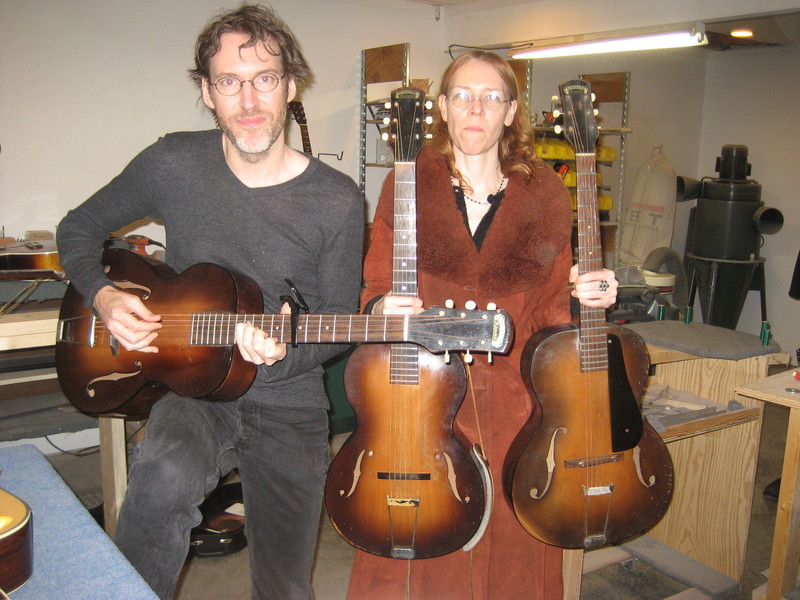
David Rawlings with his 1935 Epiphone Olympic


Kamis, 12 Juli 2012

Alma Flamenca

In the southern Spanish peninsula of Iberia is the autonomous community of Andalusia. The name traces back to the Arabic word, Al-Andalus. This part of Spain was settled by Muslims, Romani, Carthaginians, Greeks, Roman, Phoenicians, Iberians, Sephardic Jews and other diverse groups.

The art of lutherie or stringed instrument building has long been associated with Spain. The luthiers of Andalusia made instruments in a wide range of prices, largely based on the materials used, and the amount of decoration. The cheapest guitars were often simple, basic instruments made from the less expensive local woods such as cypress, rather than imported rosewood.

It was here that a style of playing known as Flamenco flourished. Flamenco is dance music. In addition to playing the strings, Flamenco guitar utilizes percussive tapping of the guitars body.


A friend once said, “Nothing really changes, everything remains the same.” In the beginning, most musicians were not getting rich, as is the case today. Most could only afford and inexpensive guitar. Which might be good for Flamenco music since the instruments have a very short life span due to all the tapping and slapping of the guitars body.

So less expensive woods were used on Flamenco guitars. The tops were generally made of cypress. Sycamore was used for the back and sides. On a really good instrument the maker used rosewood.


These were hard woods and produced an increase in volume and a brighter tone that could be heard over the dancers’ shoes that had nails in the soles. Flamenco guitars are lighter than Classical guitars.

Some come with a type of celluloid pickguard known as a golpeador that protects the guitars body from the tapping and striking.

The following short film is about the making of a Flamenco guitar. It is called The Making of Alma Flamenca, which roughly translates to Soul of Flamenco.

The luthier is Vassilis Lazarides, who is a well respected Greek builder, in business since 1990. Mr. Lazarides started by constructing traditional instruments such as bouzoukis, oud, pontic and Istanbul liras and renaissance lutes.

In 1995 he began creating Flamenco and Classical guitars.

The film condenses into three minutes a job that took Lazarides 299 hours to complete. For those of you doing the math, if Lazarides spent 9 hours a day working on the guitar, it would have taken him a little over a month to complete, assuming he worked weekends.

I found the film fascinating, since you can see how the craftsman doesn’t just work with the wood, he listens to it, feels it and determines how much vibration will occur.

The film features the incredible playing of guitarist Edsart Udo De Haes.


Minggu, 01 Juli 2012

Guitar Pick Punch

A good friend sent information to me about this amazing little device. I am surprised no one has come up with this idea until now. This is a portable, easy-to-use guitar pick punch.


Ions ago, when I first started playing guitar, I was forever losing picks. I'd buy a half dozen at the music store and a week later friends would borrow them or they magically disappeared from my guitar case.

Let's face it, guitar picks are small, usually fairly inexpensive and easily misplaced. They may fly out of your hand when you are on stage playing or fall into the soundhole of your acoustic guitar.

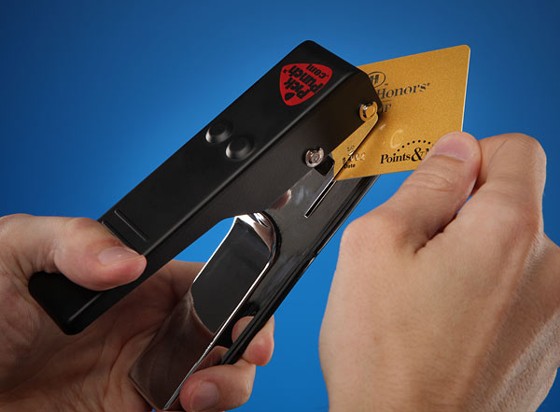
The Guitar Pick Punch is about the size of a 6" desk stapler, so it can easily fit into your gig bag or guitar case. It accepts a variety of materials as long as they are no more than 0.9mm thick. If you need a heavier pick, you can make two and glue them together.


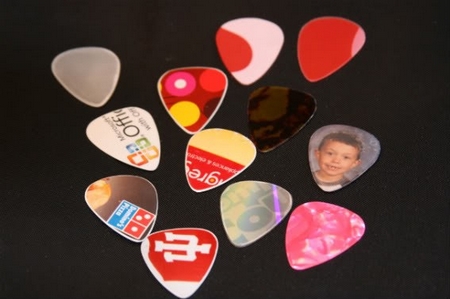
Do you have an expired credit card? Turn it into a guitar pick. How about a store shopping card club that you no longer use? Turn it into a guitar pick. How about a used up gift card or some plastic packaging material that is relatively thick can be your guitar pick in an instant.


You just insert the material into the Guitar Pick Punch and squeeze out your style 351 pick in an instant.

It sells for approximately $25 USD


This is another brand called the Pickmaster Plectrum Punch. It sells for $39 USD and is available through Amazon.com


Selasa, 26 Juni 2012

Gibson Super 400

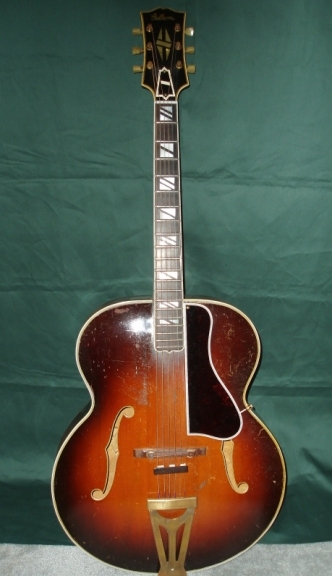
1938 Gibson Super 400
I watched an old episode of Antiques Road Show last night. One of the featured articles was a pristine Stromberg Master 400. It was a beautiful instrument with a natural finish.

Stromberg Master 400

The lady that inherited the guitar had it appraised at a music store and they valued it at $1500 to $2000. It was actually worth around $25,000.

The Strombergs of Boston and John D’Angelico of New York City based their guitar designs on the Gibson L5, which was not only one of the finest guitars ever produced but also one of the most historically significant guitars.


D'Angelico Excel
Each luthier attempted to build a better instrument than a Gibson. Not to diminish Gibson guitars in anyway, but both succeeded.


Paul Yandells 400
Stromberg’s idea was bigger is better, so their Master 400 was an inch larger than the Gibson Super 400.

 D’Angelico's Excel was much more elaborate.


1929 L-5
This guitar was introduced in 1923 as the Gibson L5, during an era when guitarists in big bands were looking for a guitar that could cut through the horn section.

By 1934 the guitar was renamed the Gibson Super 400. Its grand auditorium body shape is not unlike Orville Gibson’s 1902 Style O model. The L5 was part of what Gibson called the Master Series. This included the legendary F-5 mandolin, H-5 mandola and K-5 mando-cello and of course the L5 guitar. All were created in an era when Mandolin orchestras were popular.

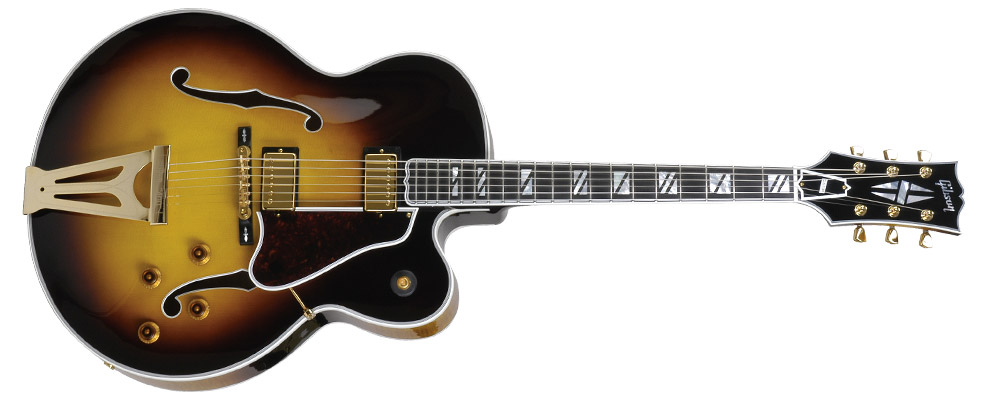
New Super 400CES
As with many Gibson guitars, the numerical designation depicts the instruments original price tag. Four-hundred dollars was quite a price in 1930’s America.


(The current suggested retail price for a brand-new Super 400 CES is $14,099. A new Gibson L5 acoustic will set you back $6,774. At present Gibson does not offer a Super 400 acoustic model.

The Super 400 is perhaps the finest Gibson that was ever produced. It was also the largest guitar that the Gibson Guitar Corporation had produced. The original models came with a hand-engraved tailpiece and finger rest support. The early models had engraved truss rod covers that still stated this was an L-5 Super.

By 1939 the model the truss cover were changed and the designation Super 400 was official. Changes were made to the design. The upper bout was enlarged and there was no hand engraving on the tailpiece. The f-holes were enlarged on this instrument. A cutaway model was also offered. This was designated the Super 400P or premiere. Later on Gibson changed the cutaway designation to C.


1956 Super 400CES
It was not until the 1950’s that Gibson electrified this instrument and designated it the Super 400 CES for Cutaway Electric Spanish. This model came with twin P-90 pickups with black plastic covers and individual volume and tone controls for each pickup and a three way toggle switch. On mid-1950 models the pickups were changed to Alnico V pickups. By 1957 twin humbuckers were standard. On the CES, the top was slightly thickened to eliminate feedback.

Beautiful neck heel cap
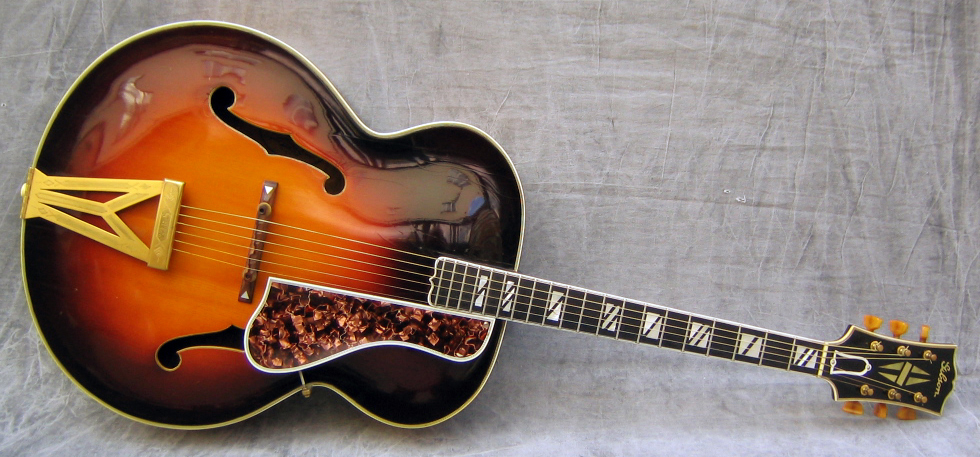
The Super 400 had an 18” wide body, an adjustable bridge and manufactured with a carved spruce top, figured maple, back and sides. The tailpiece was a gold-plated Y shaped model.


The f-holes had triple binding. The pick guard was a brown pearloid model. The beautiful bound ebony fretboard came with split block inlays.

Click to see L5 logo
The peg head had diamond inlays and open-backed Grover tuners. All of the hardware was gold plated and the heel cap was engraved with the model name. The original models were produced in brown (tobacco) sunburst. The first batches with Super L5 engraved on the truss rod cover are very rare and most coveted by collectors. These are also known as the Super L5 Deluxe.


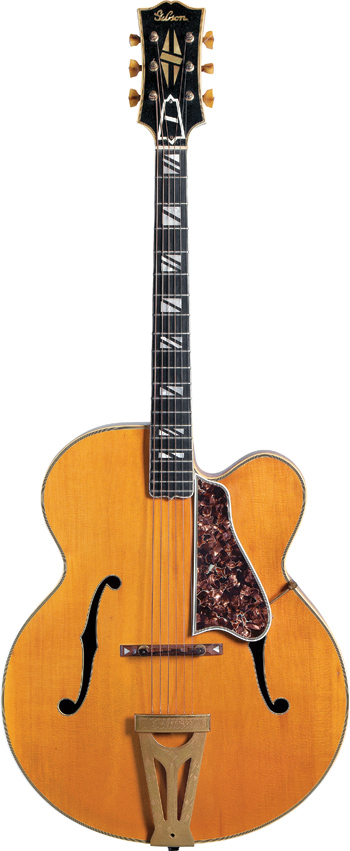
By 1939 the guitar was offered with a single Venetian cutaway and known as the Super 400P. Other changes occurred to this model including the switch to Kluson tuners with amber tulip shaped buttons and a natural finish became an option.

Production at the Gibson factory was halted in 1941 due to the war effort.


Super 400PN


Guitar operations resumed in 1948, after the war ended. The Super 400P was re-christened the Super 400C.


With P-90's
It was in 1951 that Gibson released an electric version of the Super 400 called the Super 400 CES for cutaway-electric-Spanish.


This guitar had a slightly thicker top, to eliminate feedback. It originally came with twin P-90 pickups, each with its own volume and tone control and a three-way toggle switch to control them. The P-90's were updated to Alnico V pickups and in 1957 Gibson used twin humbuckers.


By 1952 a natural finish version of the 400 CES was available and named the 400 CESN (N for natural)

It was in 1955 when Gibson decided to discontinue the Super 400 and Super 400N guitars from their product line up. By 1982, slumping sales of the Super 400 CESN brought an end to this model and in 1987 the Super 400 CES was no longer being manufactured.

One rather rare model I have come across is a Gibson Super 400 CES with a Florentine cutaway manufactured in 1966.

There have been some reissues in the 1990’s on a limited run basis. In 2000 Gibson had a very limited run of Super 400 CES models with the Charlie Christian pickup.

The Super 400 CES is currently being offered on Gibson’s home page.


The only other current models that would be similar are the one pickup Wes Montgomery L5 CES and Lee Ritenour L5 CES models and the twin pickup Custom L5 CES model.

There are some very notable players of the Super 400 CES other than Mr. Montgomery and Mr. Ritenour. Scotty Moore played one on Elvis’ 1968 live concert.


Merle with Super 400
Merle Travis favored this guitar. His instrument was highly stylized. His son Thom Bresh plays a similar instrument.. Both men added Bigsby tailpieces with extended bars.


Eddie and Alonzo Pennington
photo by Michael J. Stewart
Well known Kentucky thumbpicker Eddie Pennington plays a 1956 model of the Gibson Super 400 CES.


If you watch the following videos, pay attention to how massive a guitar this is.


Before Merle Travis passed away, the Gibson Guitar Company asked him to donate his guitar to the Country Music Hall of Fame in Nashville, Tennessee. In turn, Gibson built an exact replica of his special modified Super 400 CES. It is interesting to note that Merle's new guitar had a wooden center block similar to what is found on ES-335 models.